Blog

We work, then we ship

This blog is shipping. It’s a continuous reminder to me to get the work done. I’m at a point where I can now write every morning. I write here, and I write in my other media (at this time a novel, which I started during NaNoWriMo, but which has been a holdover).

Work completed isn’t much until we get it out. Really, it isn’t completed until you put it out. And it’s scary to put it out. There are times when I’d rather not see the finished product.

I do some work in improvisational acting, and that’s instantaneous shipping. That’s getting up, creating a scene (doing the work) and performing it in front of an audience (shipping), all in one moment. Terrifying!

But doing that, it’s helping me here. It’s helping me everywhere. Because in improv, as in any other work, it’s okay to fail. Maybe one project lands flat. Flatter than flat. Just put it in the dungheap and move on.

Seth Godin has a graph of shipping that looks like this:

6a00d83451b31569e2017ee8407661970d-500wi.jpgOriginal post here.

This is specifically for the publication of a book. But it applies to any artistic medium. The Y-axis is the joy you feel for the project, and the X-axis shows time passing with each milestone. I think data point 6 is even lower than what’s shown because fear can take hold. That resistance.

But it’s so important to ship. To accept that fear. That fear is a gift. It’s your body telling you that what you’re doing may very well be important. So don’t stop now. Accept the gift, and get your idea out there.

Adventuring

I think some of the things that make this world so amazing are the people who go out and live life like no other. Take for instance Leon McCarron. Contributing writer to Adventure Magazine, author of such books as The Land Beyond and The Road Headed West, he set out after University on a bike ride halfway around the world. Then decided to keep traveling.

According to McCarron:

“There was a time when explorers traveled to mark the blank spots on the map—but now, in the digital age with fast, inexpensive transportation to once-hidden corners of our world, there’s far less call for flag-planting.

Instead, I see the modern frontier of adventure as storytelling; using immersive, adventurous travel to uncover new ideas. Adventure also applies on a smaller scale, one that’s accessible for all. It can be a daily practice in which we choose to do something different, something that creates a new experience—and that can happen as easily in London as it can in Ladakh. Adventure is everywhere, if we know where to look.”

The challenge is to create those new experiences. Look for the miraculous in your everyday life.

Down to the wire

Here it is, December 2019. Have you accomplished all that you wanted to this year? I know I haven’t. Sometime later this month I’ll do a personal check-in, showcasing some successes and failures of the year.

I recommend you do the same.

Try to think back to the resolutions you made on New Year’s last. Then, you can set them aside. Resolutions tend to be thinly-veiled attempts to make us live the lives we think we should have.

Really, just be honest with yourself over what worked and what didn’t this year? And ask yourself why? Maybe you’ll find 2020 is a time for new beginnings, or to recommit to the things that you really enjoyed in 2019. Either way, if you start thinking about it now, it won’t come as such a shock come January 1.

What I Read, November 2019

Books Bought:

  • Summer – Karl Ove Knausgaard
  • Awareness – Anthony De Mello
  • Hellblazer #1 (2019) – DC Comics
  • Basketful of Heads #1 (2019) – DC Comics
  • Doctor Strange Annual #1 (2019) – Marvel Comics
  • Eternal Thirst of Dracula Book 2 #1 (2019) – American Mythology Productions
  • Eternal Thirst of Dracula Book 2 #2 (2019) – American Mythology Productions
  • The Collector’s Dracula Book One (1994) – Millennium Publications
  • Nosferatu: Plague of Terror #1 (1991) – Millennium Publications
  • Nosferatu: Plague of Terror #2 (1991) – Millennium Publications
  • Nosferatu: Plague of Terror #4 (1992) – Millennium Publications

Books Read:

  • Monsters Among Us: An Exploration of Otherworldy Bigfoots, Wolfmen, Portals, Phantoms, and Odd Phenomena – Linda S. Godfrey
  • Dracula: A Mystery Story – Bram Stoker
  • Basketful of Heads #1 (2019) – DC Comics
  • Doctor Strange Annual #1 (2019) – Marvel Comics
  • Eternal Thirst of Dracula Book 2 #1 (2019) – American Mythology Productions
  • Eternal Thirst of Dracula Book 2 #2 (2019) – American Mythology Productions
  • The Collector’s Dracula Book One (1994) – Millennium Publications

I hadn’t intended such a horror-themed collection for November, but let’s go ahead and start back at the beginning. October.

As I was picking out books for the month of October, browsing my shelves for unread titles and walking around the library, I happened upon Godfrey’s Monsters Among Us. It was a little heftier than some of the others I was looking at, so I waited to start it until the last moment. It missed its inclusion into October’s list so it got stuck here.

In Monsters Among Us, paranormal researcher Linda Godfrey speaks with people who have had and does investigative work regarding unusual events. These events take the form of upright dog creatures, individuals transforming into beasts, mysterious lights, household supernatural occurrences, and other strange items. When it comes to the mysterious you run into the very typical kinds of questions:

  • How accurate is the reporting of the event?
  • How trustworthy are the witness statements?
  • How far off-pitch is the reporter’s opinion on the subject?
  • And, of course, what actually happened?

Now in general, I tend to believe some things well within the realm of wu-wu. Mysterious forces, supernatural occurrences – I think that there is plenty we don’t understand as a race, and perhaps we’ll never understand. That being said, some items here gave me pause. Logical fallacies in the way the conclusions were made for instance. I have a thing about logical thinking, and incorrect use of syllogisms is one of my pet peeves. (Why, I couldn’t even begin to tell you.)

And still, this book had me wondering. I find myself looking around, checking the woods as I drive. There are places I’ve marked on the map that I want to visit: Skinwalker Ranch in Utah and Black River Falls in Wisconsin. I like the unknown. I think more of the world should be unknown.

That is a good segue to Dracula. Man, this book consumed my month. Partially due to my only giving it about thirty to forty-five minutes a night. But I was committed, and I was going to finish it. So I did.

I like what was said about it in the foreword: “Dracula is one of those books people are familiar with, without ever reading.” And how true that is. I had tried reading this book years ago, but it was beyond me then. It would have been beyond me now, was I not so intent on getting through it. The language is heavy, told in first-person narratives either as journal entries, articles, logbooks, or letters, memos, and telegrams. It runs fairly chronologically, but with some jumpiness.

For a book over one-hundred twenty years old, it still works very well. Though the world is smaller than it was then, what with the internet, telephones, and airplanes, the quiet corners of the world could still hold unknown horrors (as Linda Godfrey tried to illustrate). As a matter of fact, Stephen King’s Salem’s Lot is a partial adaptation of Dracula, imagining the vampire curse arriving in a sleepy New England town, rather than in London.

And I like the characters better than what I’ve seen in the film adaptations. Lucy isn’t as flirty, and much more likable. Harker has a hard time but owns up to what needs doing. Van Helsing isn’t one-note, but rather himself fights against science to accept the possibility of such horror. And Dracula, who is barely present as an actual character throughout much of the novel, is the mystery, and the terror. And I think that’s where the sticking power of the book lies – in his absence, more than his presence.

It’s like Spielberg’s Jaws. What with so many mechanical problems, the shark wasn’t able to be in many of the scenes it was planned for. And yet, most film historians agree that’s what makes the movie effective. That it stays hidden.

In Barry Keith Grant’s Quick Takes Book, titled Monster Cinema, he writes, “Betokening the importance of the monster’s physical difference, monster movies are often structured around the gradual reveal of the creature or creatures, building suspense and expectation in viewers until the inevitable ‘money shot,’ a dramatic peak when the monster in all its intended hideousness is fully shown.”

Of course, Stoker’s Dracula looks fairly human, if one of “extraordinary pallor.” Only when the monster is revealed can the protagonists envision the nonhumanity. “Dracula is a gothic horror novel, an adventure novel, and a character study of evil, all in one book.”

Sometime during the month, and in my reading of Dracula, I was informed of DC Comics partnering with Joe Hill to release a series of horror comics. Well, I tracked down Basketful of Heads at a shop I used to frequent in Longwood while I was on my way to a gig in Orlando. Issue one is all set-up, with criminals on the loose, hero and heroine in a house with the potential for catastrophe, and a magical Nordic axe. Issue two came out on Wednesday, but I haven’t had a chance to read it yet.

So, being in the comic shop I perused some other titles. I picked up some Dracula comics, and a few Nosferatu issues to complete a four-issue arc. Also Doctor Strange and Hellblazer. November remained a month of delving into the unknown.

The other books I purchased were Knausgaard’s Summer to complete my four seasons, and Awareness – one of Timothy Ferriss’s most recommended books. I’ll read that in December.

And that, as they say, is that. The lineup for December is less classic-heavy, I assure you. I’m currently eyeing a book by Bill Bryson, or maybe The Adventures of Tintin. We’ll see where the mood takes me. Until then…

Thanksgiving

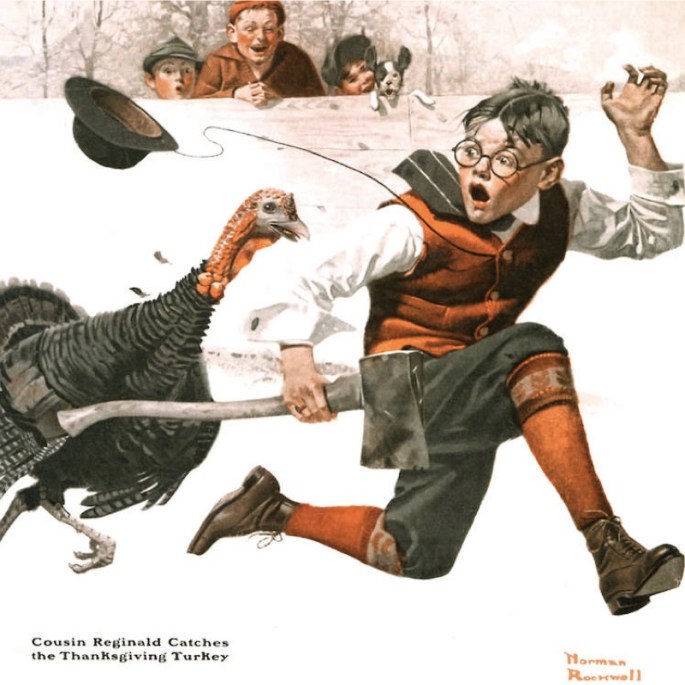
It’s been three years since I’ve become a vegetarian. I’m often asked why. No, it’s not because I was chased by a killer turkey.

I had toyed with the idea before. When I was younger, twelve maybe, I tried to go vegetarian. I didn’t receive much support from my family.

But the reason behind it was that I felt guilty for eating an animal that had died just so that I could eat it.

There’s a branch of Buddhism that sends it monks out on pilgrimage. They are graciously welcomed into houses, and allowed to partake of any meal that the family is providing. However, if the family slaughters an animal to celebrate the visiting monk, the pilgrim may not eat of it, as it was killed explicitly for his arrival.

In much the same way, I decline to eat any meat. Of course, no animal was killed expressly for me. Yet, the animal was killed with the intention that someone would purchase and eat it. So I refrain.

It’s easier being a vegetarian now than even ten or fifteen years ago. Beliefs that were on the fringe not so long ago have come to the forefront, and even current fringe beliefs are generally better accepted by the public. So it’s a good time to be a vegetarian.

Weekly Rundown

And here it is, my Black Friday edition of the Weekly Rundown. As no one will be reading this today I’ll go ahead and post at 2 am. Good morning!

This Black Friday I’m taking REI’s suggestion of getting out into the wilderness. #OptOutside. I’m up in Pennsylvania, hanging out with the Amish. No, really I am. I’ll put up some pictures later this week. But here we go!

What I’m reading: Not Dracula! Finally finished it. After finishing it, I spent some time with Austin Kleon’s Keep Going: 10 Ways to Stay Creative in Good Times and Bad. I’ve had the book for a while but hadn’t finished it. I dug it out while putting my notebook together, and figured I’d finish it.

What I’m listening to: Audiobook version of Leigh Bardugo’s Ninth House. I listened a lot of the way up to PA. The author’s first book for adults, we have occultism and Ivy League, homicide and mystery. I’d read at least one of Bardugo’s Grisha books before, and this one has much the same flow and tonality; if a bit darker.

What I’m spending time with: Routines. If you’ve read this week you’ll notice that it was a theme. I decided to fix my routine earlier in the month, and as a result I had a few thoughts that popped up. Four posts later, I’m not sure I’m done talking about routines. But that’ll be for later entries.

Other things of interest:

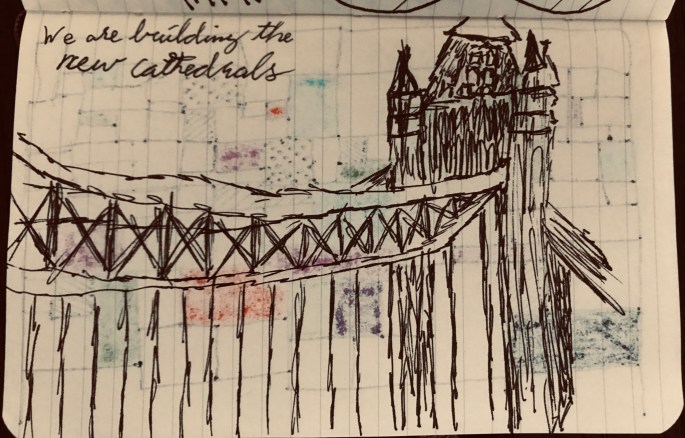
In case you don’t believe me about my skill, here’s one example…

IMG_3538

…and it’s one of my better sketches. But, as I always say: Fail again, fail better! 😉

Routines pt. 4

So, you have a routine that’s working for you. Or maybe several routines that get you throughout your day, or your week. You’re not in a rut, and you’re mindfully going along. The routine’s in place, and now you can avoid any discomfort where your routine is concerned.

Wrong. The discomfort may just be what you want.

If the discomfort is Resistance. As Steven Pressfield said of Resistance, “We experience it as an energy field radiating from work-in-potential. It’s a repelling force. It’s negative. Its aim is to shove us away, distract us, prevent us from doing our work.”

One of the sad things about a routine is that Resistance can use it to discourage us from doing real work. We issue excuses about it not being a part of the routine. We quantify and qualify our responses. We demur.

However, if we’re mindful, and honest, we’ll notice whether or not it’s the work that we need to be doing.

Routines pt. 3

Let’s say you are stuck. You’ve found yourself in a rut that you can’t seem to get out of. Maybe it’s work; maybe it’s a relationship; maybe it’s everything. What do you do?

Like all good programs, the first step is admitting the problem. And you’ve done that now. You have a problem – it’s a rut.

The next step gets harder. Part of solving it is being mindful throughout your day.

The other part is taking an honest inventory of your life. Notice where your attention is pulled. Do you have trouble performing certain tasks as opposed to others? What are you phoning in? What doesn’t really interest you?

If you say it’s your entire job, then maybe it’s time to find something else. But most people tend to enjoy certain aspects of their work, if not the entire situation. Find ways to rekindle that interest.

The same can be true of relationships. Some of the interactions may not be working, but there are probably parts that you still really enjoy. Be honest with yourself.

When we get in a rut, we can put blinders on. We try to ignore where the problem actually is, and focus on the fact that we’re just not feeling particularly happy with our situation. But we have to be honest.

Take a good, hard look. And then evaluate.

Routines pt. 2

There’s a flip-side to routines: complacency. Complacency breeds a feeling of settling. Settle enough times, and you find yourself in a rut.

First of all, it’s easy to find yourself complacent in your situations. Routines can be used to auto-program your life, and then you can just set the cruise control. How to prevent this? Be mindful.

Being mindful in your day-to-day will create moments of miraculous significance – even in the mundane. Being mindful will illicit feelings of joy, and sorrow, and peace. Complacency means you’re looking at your situation and you’re okay with it.

Peace is looking at the situation and knowing that it’s exactly where you are meant to be.

Routines pt. 1

The benefit of routines is the creation of a kind of daily specialization. Routines program your body to daily perform the same tasks (or similar tasks) at the same time. Your body knowing this, it starts to prepare for that task as the time nears.

You free up precious decision-making capabilities, your mind already aware of what you’re going to be doing. Then it can focus on limiting or ignoring potential distractions.

Routines are extremely beneficial, and routines can be designed around any number of specific needs – morning routines; workouts; meal planning; scheduling meetings (or running meetings); etc.

Some examples of morning routines can be found in My Morning Routine from Benjamin Spall and Michael Xander. 99U has a small book called Manage Your Day-To-Day. And of course, Tim Ferriss’s books Tools of Titans and Tribe of Mentors are full of examples you can use.