Another Friday

Well, it’s been a while since I listed things I was looking at or getting into. So, here it goes:

Book I’ve been reading: The Name of the Rose by Umberto Eco. I’d seen the Sean Connery film years ago, then devoted some time to its early chapters sitting in a Barnes & Noble circa 2003-2004. I didn’t buy the book, and at the time didn’t seem to fully grasp it. Now I’m giving it another chance.

What I’ve been listening to: Evita, the revival featuring Elena Roger and Ricky Martin. I’m a swing for a production of Evita right now (opening night is tonight) and I’ve been brushing up on my Argentinian.

What I’ve been watching: Lost Girl. It’s on Netflix, and had been sitting in the queue for some time (years? Hard to tell.). I do remember seeing ads for it on SyFy at some point. It’s good. A little formulaic, but I had actually been looking at differences in seelie/unseelie over the past two weeks, so starting this kind of came at a perfect time. (It’s a show about a bisexual succubus learning that there are courts of Fae in the world, and she must navigate the unique environments of faerie life.) Stars Anna Silk as Bo and Ksenia Solo as Kenzi (who was also on Turn: Washington’s Spies).

Other things of note:
Dorian almost came across Florida. Everyone knows that, but here’s a little bit of why forecasting hurricanes is hard.
Seth Godin writes an interesting post about what we own.
How to cook in a Donabe – the Japanese ceramic wonder pot.

A post a day?

I use my iPhone’s Notes app pretty religiously. Here’s a screen shot:

IMG_2338

So, this awkward little snapshot into my thought processes is embarrassing. But the one post a day idea I jotted down on March 11 came back up on April 1st, when I was listening to the first conversation Seth Godin and Tim Ferris had, back in early 2016.

Seth said, “The first thing I would say is everyone should blog, even if it’s not under their own name, every single day. If you are in public making predictions and noticing things, your life gets better.

Because you will find a discipline that can’t help but benefit you. If you want to do it in a diary, that’s fine. But the problem with diaries is because they’re private, you can start hiding. In public, in this blog, there it is. Six weeks ago you said this; 12 weeks ago you said that. Are you able, every day, to say one thing that’s new that you’re willing to stand behind? I think that’s just a huge, wonderful practice.”

Now, will I post every day? Who knows. But will I try? You betcha!

March Reading List

March, 2019

Books Bought:

  • The Essential Drucker – Peter Drucker
  • The Effective Executive – Peter Drucker
  • The Intelligent Investor – Benjamin Graham
  • Kraken – China Mieville
  • This is Marketing – Seth Godin

Books Read:

  • This is Marketing – Seth Godin
  • Kraken – China Mieville (unfinished)
  • The Aspirational Investor – Ashvin B. Chhabra
  • Tools of Titans – Tim Ferriss (unfinished)

For March, I didn’t get a whole lot done. Bought a few used books, read a little. March was a transitional month, one job shifting to the next. The last week in March was the first week of work, and it was a lot of hours in the new role.

This is Marketing – quintessential Godin. For whatever reason, any time I listen to him I generate ideas left and right. It’s motivational, and I enjoy everything about his work. I have The Icarus Deception around somewhere, and I may need to reread that as well soon.

Kraken, off to a strange start. The mystery grabbed me finally, about sixty pages in, but I don’t know if it will keep hold of me. I’m curious to see how it all plays out. It reminds me a bit of Christopher Moore, but with less humor. Maybe not less humor, but different humor. And I miss Leon already…

The Aspirational Investor came recommended, so I gave it a try. My money in the markets usually goes up and down, and I just put more in every month. At some point I may do more with it. That remains to be seen. This book was fine, but it wasn’t really new information. I did like the three-tier breakdown of risk, which I’ll likely use in my investments.

And then Ferriss, which I just pull from time to time. This month, reading about acroyoga has led me to further exploration of that activity.

April Fools’

I listened to Tim Ferriss and Seth Godin on the Tim Ferris podcast a few weeks ago. They spoke about Seth’s April fools’ joke of a few years prior. They discuss how, after emailing their lists that the blog would be coming to an end, they received angry notes from their followers. Followers that weren’t in on the joke, and how fear led them to respond.

The truth is, we mostly operate out of fear. It’s stepping away from our fears, and into that other that we find out what we’re here to do. That we’re not playing a zero-sum game, but rather a win-win infinite game – that’s just to be enjoyed.

Your joke:

A man goes to the barber and the barber asks, “How would you like your hair cut?”

The man answers, “In silence.”

Authenticity

“One must know what one wants to be,” the eighteenth-century French mathematician Émilie du Châtelet wrote in weighing the nature of genius. (From Brain Pickings).

Lots of smart people have spoken or written about being true to yourself. Why is that? What is so important about being your authentic self?

There are two elements to this. The first is: an authentic person is doing that thing which she was put here to do. The feeling of absolute joy that comes from being authentic is contagious, and that’s why authentic people are viewed as charismatic, agreeable, and engaging.

Everyone has a purpose. And, according to Oprah Winfrey, ‘Your real job in life is to figure out as soon as possible what that is, who you are meant to be, and begin to honor your calling in the best way possible.'” (Oprah’s new book, The Path Made Clear).

The other element is the concern of authenticity preventing some from showing up. As Seth Godin puts it in his interview on the Tim Ferriss show, “Which means, and this is someplace I’ve gotten in trouble before, authenticity is totally overrated, totally. That I don’t want an authentic surgeon who says, ‘I don’t really feel like doing knee surgery today.’ I want a professional who shows up whatever they feel like, right?

While I view that as a valid point, and I greatly admire Seth Godin and all the work he’s done (I’ve read a number of his books, some multiple times), I believe that this example is more about a lazy authenticity, rather than it being authentic.

The surgeon in Godin’s example is (hopefully) being authentic in being a surgeon. That’s what fuels his life. If he come in and says he doesn’t feel like doing knee surgery today, then it’s not in line with his authentic self. Or, he didn’t want to be a knee surgeon to begin with.

Authenticity, in my view, is something that will give us energy.

Now I do believe that we may find ourselves aligned to our authenticity, while not fully being authentic. That’s why you see so many Generation X and Y switching careers, rather than staying in one for their whole life. (One of the reasons.) Because they are searching for authenticity. But in the job you’re doing – the one you’ve agreed to do for the time being – you still need to show up. To do your best.

What does this mean?

Half the time, I’m not sure of the results.

The other half of the time, I’m sure, but I’m wrong about results better than 50% when I am sure.

So, really, I know very little. I’m just winging it. But aren’t we all?

I don’t know what programs are going to be successful. I don’t know which blog posts are going to be read. I don’t know who tunes in to my radio broadcasts, or if anyone downloads the podcast.

But, all in all, it’s an easy way to put something out there.

Steven Pressfield would say it’s doing the work. Seth Godin would call it “shipping art”. Some may just call it product.

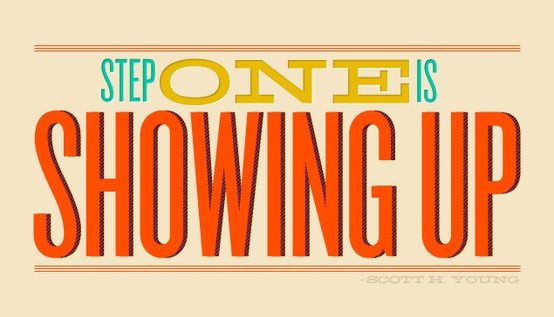
But that’s showing up.

And really, that is what it’s all about. Showing up. Because decisions are made by people who show up.

When will the revolution revolve?

It’s scary to live today. There’s a resistance to change, and that resistance is showing up in violent ways. Yet, why are we now so change adverse? The industrial revolution was nearly three hundred years ago. Since that time, it’s been non-stop change. The changes that branched out from that revolution are: the industrial mindset and the alternative mindset.

In essence, what you have us the established – the status quo. And then you have the alternative. Thinkers, creatives, revolutionaries, heretics, those that come along and bring the most disruptive tools they can: ideas. And once an idea is hatched, and if it firmly takes hold, it becomes the new status quo. Perhaps the idea originators are satisfied with that. Perhaps they stop generating original ideas. But someone won’t, that much is certain. Someone won’t settle. Someone will not abide the status quo. For every status quo, there is someone who has an alternative idea.

Generally, and I’d argue that it’s a universal truism, though I’m open to the fact that it may not be, that looking to adhere to a past status quo, once it has been replaced, will not bring with it any positive outcome. Adherents to past systems are often the most dangerous, and not in the form of ideation. Rather, they cling unflinchingly to a system already shown to be obsolete. I’m thinking of course of racism, and the violence and rhetoric of the past week.

Clinging to past perceptions and prejudices is no way to inhabit a current moment. Even with what the status quo is now, it is a time of unrest. Movements are springing up, the products of ideas, with the hopes of unifying. Detractors as well, both with the desire to push ahead, and forge new ground, or with the hope to reinstate old patterns – those former glories.

Occasionally it’s hard to tell the difference. Good salesmen will pitch you what seems like an idea – maybe even a good one. But these flim-flam men and women are just pitching rehashed examples of obsolete former glories. It’s not new. It hasn’t been new for some time.

We understand more about our deficiencies when we’re able to look back. We know that black, white, brown and yellow are equals, not subject to class division, segregation or subjugation. We know that women and men are equals and deserve equitable pay and work opportunities. We know that diversity creates more robust team dynamics, leading to better ideas, and that exposure to arts is as important to developing a young brain as is learning the fundamentals of reading, writing, math and science. We know all these things, and yet our application of this knowledge still lacks universal acceptance.

Old ways are hard to break. Status quo is the norm, and that gets easily hard-wired. Easier to stick to the path than forge a new one. Thankfully, there have always been those uncomfortable with the status quo. And we now live in a time when it’s easier than ever before to forge new territory.

“The new leverage available to everyone means that the status quo is more threatened than ever, and each employee now has the responsibility to change the rules before someone else does. This isn’t about working your way up to the top, or following the rules, and then starting down the path of changing your world. Instead, these innovations are examples of leadership. About one heretic, someone with a vision, who understood the leverage available, who went ahead and changed things.”

-Seth Godin, Tribes

And after all that, I can’t help think of that last speech in The American President. If you haven’t seen it, give it a watch.

On the reading bug

Started reading a book (the intro really, plus a few entries) that I had purchased a few weeks ago. Nick Hornby’s Ten Years in the Tub: A decade soaking in great books. First, I love books. The idea of what Hornby did for The Believer, where each month he would just talk about the books he read and ones he bought, was entirely captivating to me.

So, this being the first entry of the month, I’d like to take a cue from Nick Hornby:

June 2017

Books Bought:

  • The Republic – Plato
  • Atlantis: The Eighth Continent – Charles Berlitz
  • Designing Your Life – Bill Burnett & Dave Evans
  • Conversational Spanish in 20 Lessons – Cortina Method
  • Light on Yoga – B.K.S. Iyengar
  • The War of Art – Steven Pressfield
  • Thinking: The New Art of Decision-Making  – Edited by John Brockman

Books Read:

  • Do the Work! – Steven Pressfield
  • Dirk Gently’s Holistic Detective Agency – Douglas Adams
  • Outrageous Openness – Tosha Silver
  • The Perdition Score – Richard Kadrey
  • Sept. ’03 – Jan. ’04 of Ten Years in the Tub – Nick Hornby
  • Worth Dying For – Lee Child
  • The War of Art – Steven Pressfield (started)

What can I tell you about the books I’ve read? Or bought? Why do we do this? I found a beautiful passage in the intro to Ten Years in the Tub, written by Jess Walter:

“That the books we buy are almost as important as those  we read. From the beginning there were always two columns [referring to Hornby’s monthly article], Books Bought and Books Read. By my crude math, Nick spent somewhere around ten or fifteen grand on books he hasn’t even read. Besides showing that he did his part to support publishing during a tough economic period, this suggests something important about reading. Looking around my own obsessively crowded shelves, I see there are two categories of books I tend to keep: those I love and those I hope one day to read. If the books we read reflect the person we are, the books we hope to read might just be who we aspire to be. There is something profound in that.”

I checked out Do the Work! and Dirk Gently from the library. Both came precariously close to being returned unread, but something about each grabbed me and made me change course. The library and, by extension, book stores, are sort of a second home to me. And in this in-between period, where the old life I lived has fallen away and the new one is just breaking out of its cocoon, they function more as my first home than the place that houses my stuff.

Do the Work! walks us through the creative process, highlighting the role of resistance in creation. Now, I’m a big fan of Seth Godin. Have been since I first stumbled across The Icarus Deception, oh, three years ago. At that time I was creatively stifled, my professional and personal lives not working out the way that I had intended. He begged his readers to do the work, fight resistance, and ship! Yes! I can get on board with that.

Pressfield’s book does much the same, but not as effectively. I do feel inspired to do the work, yet I get stuck on syntax when he delves into his theory on the contradictory nature of the Universe’s role in Resistance/Assistance. I’ll likely come at this book again a year or two down the road, and see if I agree or disagree more with the sentiment. The War of Art has been on my reading list for a few years, so it was time to pull the trigger and buy it. I’m just starting it, and seeing the themes revisited from Do the Work!

Adams is always fun, and Dirk Gently’s was no exception. The thought and connectivity he puts into a book about interconnectivity gives enough laugh-out-loud moments that I found myself flying through it.

Atlantis and the course on Spanish weren’t bought, per se. Rather free books in a stack at the library. There’s a girl from Barcelona I wish I were better able to communicate with, though she speaks  English more fluidly than I do. Atlantis, eh. Always curious about the esoteric and metaphysical.

In The Perdition Score, I got to resist the character Sandman Slim, aka James Stark, as he moved up and down a supernatural Los Angeles, and back into Hell. I began reading Kadrey’s series last February, what is that, fourteen months ago? Since then, I’ve read eight and just committed to reading the ninth when I saw it in the bookstore. Perdition is probably the best of the series since Sandman Slim, but I’m a sucker for watching Stark get even when someone goes after his friends.

Another series that I just began last year but have managed to put a considerable dent in is the Jack Reacher collection, by Lee Child. Worth Dying For is well-plotted mystery, and I had trouble putting it down as well. I spent the better part of two days catching up with Mr. Reacher in a little Nebraska town run by some no-goods that were, par for the course, up to no good. It’s a satisfying read, and moves the story towards him heading back to Virginia, which they adapted for film in last year’s Never Go Back.

Tosha Silver and Iyengar’s books are part of my required reading for the yoga practice. I bought Light on Yoga from a Los Angeles Goodwill on Amazon, so it’ll arrive soon. It was like five bucks. Outrageous Openness we discussed at the yoga studio, and it seems to be of big help to those of us who have trouble letting go and trusting that Divine help will be coming.

My first experience with that concept was back in November, 2015, when I started Cameron’s The Artist’s Way. I know some crazy things can happen, once you say okay and let the Universe/Divine/God/Source start working on you.

I made it though five whole books this month, with two solid starts, and a few dips into other assorted writings. I can’t guarantee that many, but there is that new Sandman Slim out there, as well as a Reacher novel someone loaned me. Plus, there’s a stack of library books on philosophy that need to be returned this month, so it may be more likely that I get a sit down with Spinoza and Kierkegaard.