The technical

With a blog I’ve been working on for about three years (on and off), and other social media accounts I’ve had for longer – as well as the new website, a podcast, a radio show, and a new media showcase about to start production on Sunday, sorting through the technology requirements on a limited schedule is complicated.

Right now I’m working on batching blog posts so that I can have at least five done each day. The last two weeks were pretty well shot with rehearsals, a new office, and advisory council appointment orientation. As everything settles and I work on processing incoming data efficiently, I’ll lay out those inbox sorting techniques here (somewhere.)


Accountability


Remember, there are roles in which you have to produce, and there are roles when the production is its own reward. The first usually has a paycheck, or a familial compulsion.

For the latter, there is no grade. There is no paycheck. No boss saying nice work, or do it again. But this work I’m producing is something I get to hold myself accountable for. The reward is my own satisfaction, and sometimes that’s enough. 

Beware

Well, I missed the Ides of March. But what I’ve found more insidious is the barrenness of a busy life.

“Beware the barrenness of a busy life.” – Socrates

There’s so many variables in the busy life, and yet it was the same 2,100 years ago as it is today. If we don’t make time for what’s important in our life, not only do we fill our time with the unimportant but we neglect what is truly vital. Thus our life is barren.

I don’t care about Instagram

I don’t care about Instagram. And it isn’t because it isn’t cool/hip, or useful. It’s not because the pictures some people post aren’t moving, or awesome, or don’t right mind-blowing. And it isn’t because some people spend hours upon hours looking through their feeds.

It just wasn’t made for me. I’m not the market.

I could try and force myself to be the market – to use Instagram as a business tool, or as social interaction. Yes, I put up pictures every now and then. But the pictures I take are of skies and clouds. These are the things that grab my attention – wide open spaces that look untouched by any but divine hands.

So no, I don’t care about Instagram. But it doesn’t mean you shouldn’t.

Something about a rock

A rock moves not when great winds blow,
Nor does it burn when near a flame.
It may grow hot or may grow cold,
Yet the rock will remain the same.

But constant stream of gentle water
Can wear it down to smallest stone,
And what was once hard and strong
Those things it no longer owns.

Now the passage of water and of time
Can make dust of immobile boulder.
Yet still it lives, though changed forever,
And us, a little bit older.

Fear not these passings, time flowing by,
When age comes to us all.
But hold them close, those that you can,
When death has come to call.

A post a day?

I use my iPhone’s Notes app pretty religiously. Here’s a screen shot:

IMG_2338

So, this awkward little snapshot into my thought processes is embarrassing. But the one post a day idea I jotted down on March 11 came back up on April 1st, when I was listening to the first conversation Seth Godin and Tim Ferris had, back in early 2016.

Seth said, “The first thing I would say is everyone should blog, even if it’s not under their own name, every single day. If you are in public making predictions and noticing things, your life gets better.

Because you will find a discipline that can’t help but benefit you. If you want to do it in a diary, that’s fine. But the problem with diaries is because they’re private, you can start hiding. In public, in this blog, there it is. Six weeks ago you said this; 12 weeks ago you said that. Are you able, every day, to say one thing that’s new that you’re willing to stand behind? I think that’s just a huge, wonderful practice.”

Now, will I post every day? Who knows. But will I try? You betcha!

The work’s the thing

Remember who you are producing for. We don’t live to work better. We work to live better. Every job we do is a reflection of how much we appreciate ourselves. Not the company, or the product. And we may think that it’s an amazing company or product – which is why we align to it.

But there must also be balance. Don’t sacrifice life just to work. Be the living worker, and not a robot.

Journaling

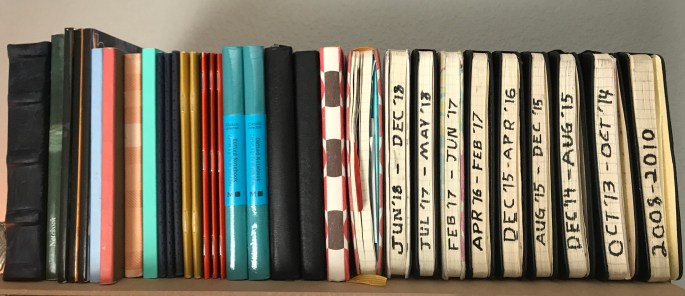
First things first. I love journals. Have since at least 1990. I had just turned 7, and what I had asked for from my dad was a notebook/journal. I know this because I still have it. (Somewhere, possibly in storage. I swear I’ve seen it recently…) It is a faded green color, with an image of rough seas. A sail boat rides the swells. I can’t recall what the style of the picture is named, but you’d know it if you saw it.

From that point on, I’ve always written stuff. Nothing coherent. A few short stories, maybe a hundred or so poems. But, I jot notes down all the time. Song lyrics. Words I want to know more about, or topics. Quotes that inspire, motivate, or enlighten me.

I heard that Charles Dickens burned his notebooks and letters annually. I wonder what is lost or gained when we let go of those thoughts written down for later investigation.

April Fools’

I listened to Tim Ferriss and Seth Godin on the Tim Ferris podcast a few weeks ago. They spoke about Seth’s April fools’ joke of a few years prior. They discuss how, after emailing their lists that the blog would be coming to an end, they received angry notes from their followers. Followers that weren’t in on the joke, and how fear led them to respond.

The truth is, we mostly operate out of fear. It’s stepping away from our fears, and into that other that we find out what we’re here to do. That we’re not playing a zero-sum game, but rather a win-win infinite game – that’s just to be enjoyed.

Your joke:

A man goes to the barber and the barber asks, “How would you like your hair cut?”

The man answers, “In silence.”

What the reviewer sees

A book review is nothing more than emotional snapshot of how an author’s work speaks to the reviewer. 

Anyone can go through a book and mark syntax or grammatical errors. That is the purview of elementary educators. What we expect reviewers to do is to read a work and tell us whether the devices the author used worked for the reviewer. Do the analogies seem out of place? Is there too much ambiguity in story. Can the protagonist be understood adequately with the given backstory?

And these understandings of the author’s work is subjective on the part of the reviewer, and the subsequent review is then only useful to someone with similar taste and understanding as the reviewer has. 

Many things are more subjective than we consider, and we are often more opinion-based than we acknowledge. Remember that when making decisions.