A post a day?

I use my iPhone’s Notes app pretty religiously. Here’s a screen shot:

IMG_2338

So, this awkward little snapshot into my thought processes is embarrassing. But the one post a day idea I jotted down on March 11 came back up on April 1st, when I was listening to the first conversation Seth Godin and Tim Ferris had, back in early 2016.

Seth said, “The first thing I would say is everyone should blog, even if it’s not under their own name, every single day. If you are in public making predictions and noticing things, your life gets better.

Because you will find a discipline that can’t help but benefit you. If you want to do it in a diary, that’s fine. But the problem with diaries is because they’re private, you can start hiding. In public, in this blog, there it is. Six weeks ago you said this; 12 weeks ago you said that. Are you able, every day, to say one thing that’s new that you’re willing to stand behind? I think that’s just a huge, wonderful practice.”

Now, will I post every day? Who knows. But will I try? You betcha!

The work’s the thing

Remember who you are producing for. We don’t live to work better. We work to live better. Every job we do is a reflection of how much we appreciate ourselves. Not the company, or the product. And we may think that it’s an amazing company or product – which is why we align to it.

But there must also be balance. Don’t sacrifice life just to work. Be the living worker, and not a robot.

Journaling

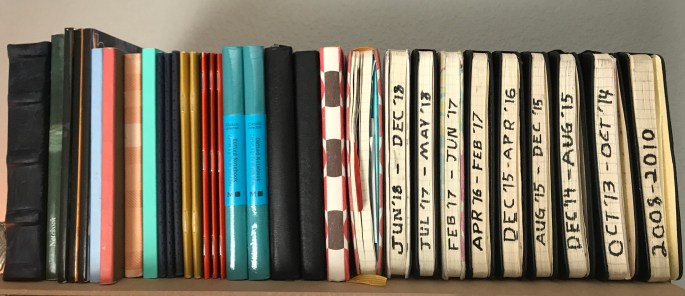
First things first. I love journals. Have since at least 1990. I had just turned 7, and what I had asked for from my dad was a notebook/journal. I know this because I still have it. (Somewhere, possibly in storage. I swear I’ve seen it recently…) It is a faded green color, with an image of rough seas. A sail boat rides the swells. I can’t recall what the style of the picture is named, but you’d know it if you saw it.

From that point on, I’ve always written stuff. Nothing coherent. A few short stories, maybe a hundred or so poems. But, I jot notes down all the time. Song lyrics. Words I want to know more about, or topics. Quotes that inspire, motivate, or enlighten me.

I heard that Charles Dickens burned his notebooks and letters annually. I wonder what is lost or gained when we let go of those thoughts written down for later investigation.

April Fools’

I listened to Tim Ferriss and Seth Godin on the Tim Ferris podcast a few weeks ago. They spoke about Seth’s April fools’ joke of a few years prior. They discuss how, after emailing their lists that the blog would be coming to an end, they received angry notes from their followers. Followers that weren’t in on the joke, and how fear led them to respond.

The truth is, we mostly operate out of fear. It’s stepping away from our fears, and into that other that we find out what we’re here to do. That we’re not playing a zero-sum game, but rather a win-win infinite game – that’s just to be enjoyed.

Your joke:

A man goes to the barber and the barber asks, “How would you like your hair cut?”

The man answers, “In silence.”

What the reviewer sees

A book review is nothing more than emotional snapshot of how an author’s work speaks to the reviewer. 

Anyone can go through a book and mark syntax or grammatical errors. That is the purview of elementary educators. What we expect reviewers to do is to read a work and tell us whether the devices the author used worked for the reviewer. Do the analogies seem out of place? Is there too much ambiguity in story. Can the protagonist be understood adequately with the given backstory?

And these understandings of the author’s work is subjective on the part of the reviewer, and the subsequent review is then only useful to someone with similar taste and understanding as the reviewer has. 

Many things are more subjective than we consider, and we are often more opinion-based than we acknowledge. Remember that when making decisions.

Tinkerbell

I had to say good bye to a friend this weekend. A friend of fifteen years. My cat Tinkerbell, aka Num Nums. I’d had her since 2004, and from house to house, job to job, she’d been my constant. 

She was an asshole. Everyone thought so, because she was. She was moody, more so than a typical cat. I refused to declaw her, because after she was spayed she hid under the bed for three days and wouldn’t come out. I couldn’t bring myself to cause any pain to come to her, so I left her claws in. I got scratched because of it, but not as much as some of my friends and family did.

Fifteen years she meowed at me, letting me know she needed food, or water, or that she had left me a hairball. She constantly went places she shouldn’t go, and I’d have to track her down – hoping I didn’t get fresh scratches. 

When I brought the dog home to meet her, she could care less. She had her space, and she’d tolerate him well enough. But she batted him in the nose more than once.

She passed peacefully in her sleep on Friday, and it’s just not the same without her.

Authenticity

“One must know what one wants to be,” the eighteenth-century French mathematician Émilie du Châtelet wrote in weighing the nature of genius. (From Brain Pickings).

Lots of smart people have spoken or written about being true to yourself. Why is that? What is so important about being your authentic self?

There are two elements to this. The first is: an authentic person is doing that thing which she was put here to do. The feeling of absolute joy that comes from being authentic is contagious, and that’s why authentic people are viewed as charismatic, agreeable, and engaging.

Everyone has a purpose. And, according to Oprah Winfrey, ‘Your real job in life is to figure out as soon as possible what that is, who you are meant to be, and begin to honor your calling in the best way possible.'” (Oprah’s new book, The Path Made Clear).

The other element is the concern of authenticity preventing some from showing up. As Seth Godin puts it in his interview on the Tim Ferriss show, “Which means, and this is someplace I’ve gotten in trouble before, authenticity is totally overrated, totally. That I don’t want an authentic surgeon who says, ‘I don’t really feel like doing knee surgery today.’ I want a professional who shows up whatever they feel like, right?

While I view that as a valid point, and I greatly admire Seth Godin and all the work he’s done (I’ve read a number of his books, some multiple times), I believe that this example is more about a lazy authenticity, rather than it being authentic.

The surgeon in Godin’s example is (hopefully) being authentic in being a surgeon. That’s what fuels his life. If he come in and says he doesn’t feel like doing knee surgery today, then it’s not in line with his authentic self. Or, he didn’t want to be a knee surgeon to begin with.

Authenticity, in my view, is something that will give us energy.

Now I do believe that we may find ourselves aligned to our authenticity, while not fully being authentic. That’s why you see so many Generation X and Y switching careers, rather than staying in one for their whole life. (One of the reasons.) Because they are searching for authenticity. But in the job you’re doing – the one you’ve agreed to do for the time being – you still need to show up. To do your best.

Monday, Monday, Monday

New job starting this morning. It’s important to remember, heading into a new job, that while you may know a lot about the industry or even the company, you may not know everything about what’s specifically going to occur. Go in with an open mind, be prepared to learn, and do your best.

Days gone by

Lots of changes over the past four weeks – job change, new ventures began, and plans coalescing.

I’ve been guilty of misusing my personal resources, and I’ve forgiven myself for that.

When the bulk of your decision making power is spent before you’ve started the real work, you’re wasting your potential. Minimize, reduce, and evaluate your value-adding activities.

The problem with applications

I’ve filled out a lot of applications. Online mostly, though still some on paper. The online revolution and conversion was ushered in between the times that I was looking for work. In 2003 I fell into my first after high school job, which I don’t even recall if I filled out an application for. It was an office manager for a nonprofit, and until the office space we had was lost, I thought it was going okay. I learned a lot about business skills in that one-man shop, though maybe not enough.

After that, I started what could have been my first career I suppose you could say. Had I not resigned to pursue professional acting, maybe I’d still be there. It was a service organization affiliated with NASCAR, and while I have many problems with the way some of that went down, I can remember fondly my times at the track.

I think from there I learned that work should be fun. Could be fun, at the very least. I was a highly effective worker, and given increasing responsibility during my time there. (In five years, I received two promotions and was asked to handle several increasing complicated aspects of the job – mostly related to computer systems or point-of-sales.) And I had fun, mostly. When the crowds started slowing to the races, then concern gripped the corporatists – cut budgets, watch the bottom dollar, churn out the returns. 

But we’re not robots. Not cogs that, if tightened, can produce two more widgets. (This theme has been coming up recently – the production of widgets.)

Long story short, when it was time to go, I knew it was time to go. The exact phrasing of my last meeting with my boss and my boss’s boss (Office Space anyone?) went like this:

My Boss: “It’s either you quit your outside activities and commit to this, or you should go somewhere else.”

Me: “I have my two weeks notice ready. Let me grab it for you.”

Now my outside activities were my first volunteer endeavors with community theatre, and I had requested a day off a week after the Daytona 500 to be involved with a professional production of an opera. Whether or not either of us were right or wrong is just a lot of conjecture, but we both did what we did. 

I go by my gut a lot. Every job I’ve known it was time to leave, I went ahead and did it. Sometimes without a safety net. Thankfully, I’ve managed to land on my feet. (This time is a little harder, as I’m more keenly aware of the level of debt I’m carrying from my student loans.)

So when I go out and look for those jobs, and I come to a website where I am filling out over and over again the same information. Name. Number. Address. Work history. Education. Etc., etc.

Exactly why we have resumes. And, truth be told, nearly all of my jobs have come through people I knew, or people who knew those people. Not online applications. So what then is the point there? 

When they ask you in their application (posted online, and responded to in the same way by every applicant) “what about this company makes you want to work here?” – the most likely honest answer is “if hired, you’ll give me a paycheck.”

Company culture isn’t bought into in an online application. And good companies will have trouble matching good applicants in that way. 

Companies – if you want good workers (and to retain them), be different. Don’t be another online application for a hopeful paycheck.

Applicants – if you want to work for a good company (and do well), be different. Bring your talents to someone who will take those talents, and let you use them. Let you fail. And then help back up.