Blog

Into hiding

One could make a case for now being a great time to hide. There’s certainly a lot to hide from.

What I find interesting is that many of us are being faced with ourselves in a way that we aren’t accustomed to. We’re mostly locked down, unable to do those things we’ve grown used to doing – such as eating out, grabbing a drink in a bar, maybe attending a movie or a show or a sporting event.

We look at ourselves, and wonder, “Now what?”

But apart from the safety we seek, we’re able to look inward in a way that our lifestyle may have been preventing. Wherever you go, that’s where you are.

It isn’t a good time to hide. It’s a good time to find yourself.

Weekly Rundown

All about Ketchikan, Volume 3.

Alaska, like much of the Country, has pretty much shut down. Bars, restaurants, the company I was working for. However, I’m fortunate to have a number of trails to explore within walking distance.

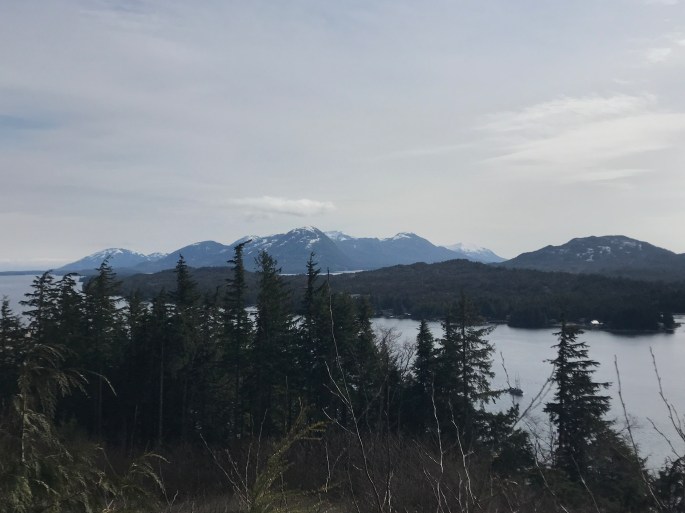
Rainbird Trail: Scenic views and a hilly wooded path, this two-and-a-half-mile walk provides a look at the Tongass Narrows and Gravina and Pennock Islands. While moving through the forest, there is a selection of spruce, cedar, hemlock, and pine trees to observe in their tree-fulness.

Rainbird View
View from Rainbird Trail overlook spot

Deer Mountain Trail: A significantly more strenuous hike than Rainbird, and currently covered in snow at an elevation of about one mile from the base, it only went part of the way up. Deer Mountain is described as “Ketchikan’s iconic and idyllic backdrop.

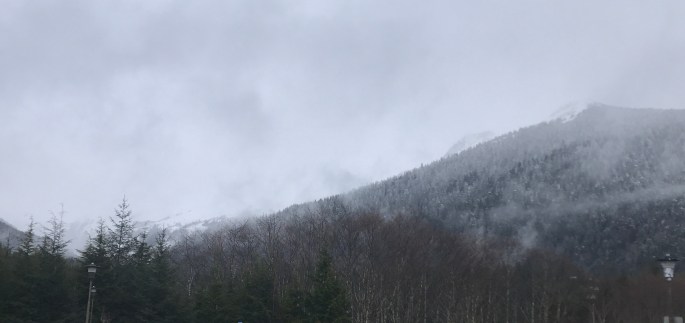
Deer Mountain in cloudy weather
A view up from the base of Deer Mountain
Deer Mountain Clearing
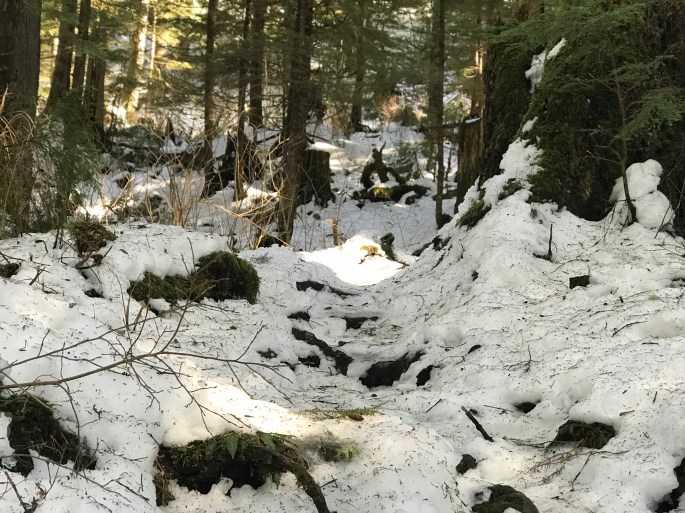
Snowy pass up the Deer Mountain Trail

Several other locations are within driving distance (only some 30 miles of highway move up the Western coast of Revilla Island), and these include Carlanna Lake Trail, Ward Lake and Perseverance Lake Trail, and the Coast Guard Beach Trail.

I only briefly headed down to Ward Lake, but anticipate further hiking over the weekend. The weather has turned sunny, while still hovering between thirty and forty degrees Fahrenheit.

Disconnected

There’s an element of misunderstanding for many of us during this time of crisis. Most of us, I expect, would rather be working, if we are among the millions now unemployed, furloughed, or stranded somewhere. If the work is front line work, in the hospitals, for instance, it’s scary work. Scary, but meaningful. Life-saving is always meaningful.

Then there are others, fortunate to work from home, or less fortunate but still required to work – delivery-service who may run the risk of infection from the job,

There’s information, there’s misinformation, and there’s fear. The fear is what gets at the heart of it. A fear that’s been creeping into the Country long before the virus emerged. A fear that life, as it was before, will never be seen again.

It’s the fear of men and women who don’t know what the new normal looks like, and the fear of younger generations who don’t know what the new ‘new normal’ will look like. We’ve been heading down this path for a while, with shifting populations, immigration ebbing and flowing, social preferences and liberalities altering on a seemingly daily basis.

What all of this should tell us is that: There is no certainty. We could fight so hard for the  America we remember as children, to restore it to what we view as its former glory, only to have even that which we’ve come to know replaced by an unexpected epidemic.

New normals will inevitably come, to be again replaced by something newer. We shouldn’t grip so tightly onto the past that we don’t savor the present. Because something could be waiting around the corner to shake the present loose, and we might like what comes after even less.

Finding that “thing”

We all want to find that one thing we’re good at. That alignment between our persona; mission and work that is fulfilling. But you know what? Chances are we’re not the first person to have done it. There’s been a lot of people doing a lot of things throughout history. Even now, nearing 8 billion people, there are only so many “things” that can be done.

But no one can do your thing like you can. No one has the same you-ness that makes your contribution value. Not finding it, that deprives the world of what you were here to offer.

As Marianne Williamson wrote in A Return to Love: Our deepest fear is not that we are inadequate. Our deepest fear is that we are powerful beyond measure. It is our light, not our darkness, that most frightens us. We ask ourselves, Who am I to be brilliant, gorgeous, talented, fabulous? Actually, who are you not to be?”


Quite a month

March was, without a doubt, the strangest month that I’ve ever been privy to. It had ups, and it had downs. Mostly downs.

We’re still waiting for answers to questions over the health and wellness of the US, and the world at large. The financial sector continues to be in an uproar, and unemployment claims are skyrocketing. And all anyone can really ask is, “When will it end?”

The best news in times like these is to remember that it will end. Sometimes it doesn’t seem to move near-fast enough towards its resolution. But we don’t always get to control the speed. All we get to control is how we respond to it.

Some are better prepared. Some are less affected. Some are struggling to get by. Yet, we’re all a part of the new landscape, and its unclear still what the new normal will be.

Wherever you go

Wherever you go, that’s where you are.

There’s a joy in solitude if you take the time to listen to it. Blocking out the concerns of the world, the struggles you may be experiencing, or the uncertainty of it all. At this moment, you get to listen to that inner voice.

What is it saying?

Hitting bottom

So Dalio’s book caused me more introspection. This, coupled with my seclusion in Alaska, has brought some things to the forefront.

“Embracing your failures – and confronting the pain they cause you and others – is the first step toward genuine improvement; it is why confession precedes forgiveness in many societies. Psychologists call this ‘hitting bottom.’ If you keep doing this you will convert the pain of facing your mistakes and weaknesses into pleasure and ‘get to the other side’…”

If you were to rate days on a scale of 1-5 with 1 being the worst and 5 being the best, in my 12,000 or so days I’ve had twenty (estimate) days I would rate as a 1. That’s less than one bad day a year. But the fact is, those days tend to stand out more than any others. Those days rank higher in my internal auditing systems than any of the other days.

Richard Michael Hui wrote this enlightening piece on mistakes, and of those twenty or so days, I’d wager that 75% were from mistakes I had made. Maybe not specifically in that moment, but at least in the moments leading up to them. And if you’re able to learn from those mistakes – to accept and forgive yourself – you’re vastly ahead of the curve.

Day hikes

I’ve been taking some day hikes, clearing my head, getting out of the house, etc. And what strikes me about this pandemic is that, while I or others will step far to the side to let each other pass (six-foot rule), it’s all very pleasant. There’s no sense of discomfort or fear. It’s just caution and a shared understanding of the experience.

As the Nation’s leaders try to sort out this mess, we on the ground just have to keep on any way we can.

Weekly Rundown

All about Ketchikan, Volume Two.

The history of Ketchikan is closely tied to fishing. As I mentioned last week, the Kadjuck Tlingits made summer fishing camps along the coast of this island at the Tongass Narrows. But it was in 1883 that a salmon saltery (fish packaging operation) was established. This saltery, started by Mike Martin, was the first such business in place.

In 1885, Loring cannery opened its doors; in 1887, the Tongass Packing Company built its cannery; other immigrants began to open businesses, and in 1900, on August the 25th, the City of Ketchikan was incorporated with a population of 459 residents.

Southeast Alaska is one of the great breeding grounds for all species of the Pacific Salmon. There are about 1,100 islands that make up the Alexander Archipelago, which themselves have steep inland ranges and streams (aided by the about 150 inches of rainfall each year). All these factors contribute to the returning salmon runs, some with upwards of one million fish!

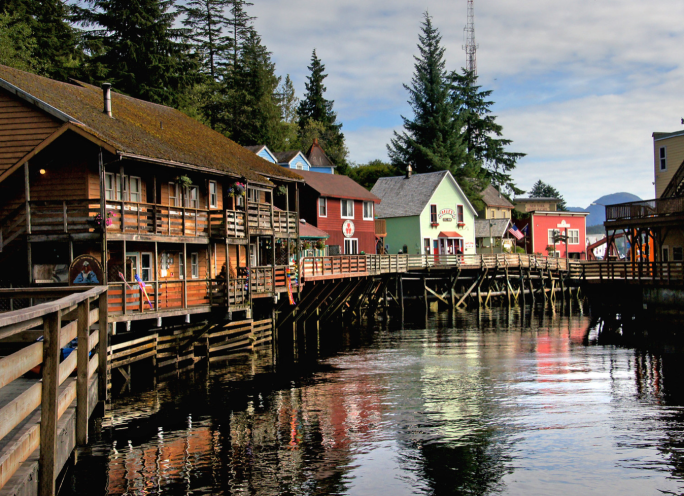
During the mid-to-late summer, salmon can be seen running over the falls and fish ladder at Creek Street, right through Downtown Ketchikan.

Creek Street