Blog

Journaling

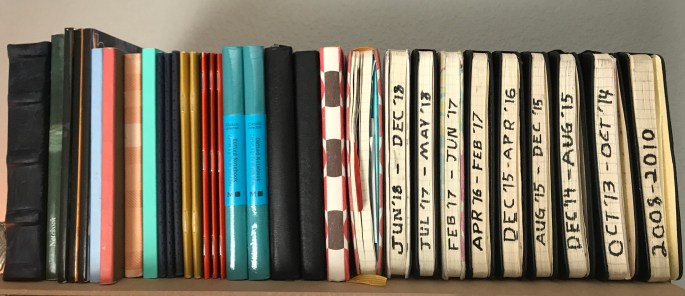
First things first. I love journals. Have since at least 1990. I had just turned 7, and what I had asked for from my dad was a notebook/journal. I know this because I still have it. (Somewhere, possibly in storage. I swear I’ve seen it recently…) It is a faded green color, with an image of rough seas. A sail boat rides the swells. I can’t recall what the style of the picture is named, but you’d know it if you saw it.

From that point on, I’ve always written stuff. Nothing coherent. A few short stories, maybe a hundred or so poems. But, I jot notes down all the time. Song lyrics. Words I want to know more about, or topics. Quotes that inspire, motivate, or enlighten me.

I heard that Charles Dickens burned his notebooks and letters annually. I wonder what is lost or gained when we let go of those thoughts written down for later investigation.

April Fools’

I listened to Tim Ferriss and Seth Godin on the Tim Ferris podcast a few weeks ago. They spoke about Seth’s April fools’ joke of a few years prior. They discuss how, after emailing their lists that the blog would be coming to an end, they received angry notes from their followers. Followers that weren’t in on the joke, and how fear led them to respond.

The truth is, we mostly operate out of fear. It’s stepping away from our fears, and into that other that we find out what we’re here to do. That we’re not playing a zero-sum game, but rather a win-win infinite game – that’s just to be enjoyed.

Your joke:

A man goes to the barber and the barber asks, “How would you like your hair cut?”

The man answers, “In silence.”

What the reviewer sees

A book review is nothing more than emotional snapshot of how an author’s work speaks to the reviewer. 

Anyone can go through a book and mark syntax or grammatical errors. That is the purview of elementary educators. What we expect reviewers to do is to read a work and tell us whether the devices the author used worked for the reviewer. Do the analogies seem out of place? Is there too much ambiguity in story. Can the protagonist be understood adequately with the given backstory?

And these understandings of the author’s work is subjective on the part of the reviewer, and the subsequent review is then only useful to someone with similar taste and understanding as the reviewer has. 

Many things are more subjective than we consider, and we are often more opinion-based than we acknowledge. Remember that when making decisions.

Grief

I began keeping this blog (the second or third time) as an outlet for expressing grief, while on my spiritual journey. At the time I wasn’t sure where I was going.

Mostly I still feel that way. But the complicated grief that I was struggling with has mostly faded away. Grief is an unusual thing – I like the saying by Jamie Anderson: “grief is just love with no place to go.”

Grief-Ive-learned

A lot of grief feels that way. Wishing my grandmother was here. Or working out the issues from my failed engagement. And now saying goodbye to my fur baby. Grief can be overwhelming. And it can be enlightening.

I just have to keep telling myself to “lean in”.

Tinkerbell

I had to say good bye to a friend this weekend. A friend of fifteen years. My cat Tinkerbell, aka Num Nums. I’d had her since 2004, and from house to house, job to job, she’d been my constant. 

She was an asshole. Everyone thought so, because she was. She was moody, more so than a typical cat. I refused to declaw her, because after she was spayed she hid under the bed for three days and wouldn’t come out. I couldn’t bring myself to cause any pain to come to her, so I left her claws in. I got scratched because of it, but not as much as some of my friends and family did.

Fifteen years she meowed at me, letting me know she needed food, or water, or that she had left me a hairball. She constantly went places she shouldn’t go, and I’d have to track her down – hoping I didn’t get fresh scratches. 

When I brought the dog home to meet her, she could care less. She had her space, and she’d tolerate him well enough. But she batted him in the nose more than once.

She passed peacefully in her sleep on Friday, and it’s just not the same without her.

Authenticity

“One must know what one wants to be,” the eighteenth-century French mathematician Émilie du Châtelet wrote in weighing the nature of genius. (From Brain Pickings).

Lots of smart people have spoken or written about being true to yourself. Why is that? What is so important about being your authentic self?

There are two elements to this. The first is: an authentic person is doing that thing which she was put here to do. The feeling of absolute joy that comes from being authentic is contagious, and that’s why authentic people are viewed as charismatic, agreeable, and engaging.

Everyone has a purpose. And, according to Oprah Winfrey, ‘Your real job in life is to figure out as soon as possible what that is, who you are meant to be, and begin to honor your calling in the best way possible.'” (Oprah’s new book, The Path Made Clear).

The other element is the concern of authenticity preventing some from showing up. As Seth Godin puts it in his interview on the Tim Ferriss show, “Which means, and this is someplace I’ve gotten in trouble before, authenticity is totally overrated, totally. That I don’t want an authentic surgeon who says, ‘I don’t really feel like doing knee surgery today.’ I want a professional who shows up whatever they feel like, right?

While I view that as a valid point, and I greatly admire Seth Godin and all the work he’s done (I’ve read a number of his books, some multiple times), I believe that this example is more about a lazy authenticity, rather than it being authentic.

The surgeon in Godin’s example is (hopefully) being authentic in being a surgeon. That’s what fuels his life. If he come in and says he doesn’t feel like doing knee surgery today, then it’s not in line with his authentic self. Or, he didn’t want to be a knee surgeon to begin with.

Authenticity, in my view, is something that will give us energy.

Now I do believe that we may find ourselves aligned to our authenticity, while not fully being authentic. That’s why you see so many Generation X and Y switching careers, rather than staying in one for their whole life. (One of the reasons.) Because they are searching for authenticity. But in the job you’re doing – the one you’ve agreed to do for the time being – you still need to show up. To do your best.

Monday, Monday, Monday

New job starting this morning. It’s important to remember, heading into a new job, that while you may know a lot about the industry or even the company, you may not know everything about what’s specifically going to occur. Go in with an open mind, be prepared to learn, and do your best.

Walt Disney Universe?

With Disney’s acquisition of Fox, the Mouse has become the entertainment leader (if it wasn’t already) across multiple channels – theatrics, film, television, broadcast, merchandise, and (of course) theme parks.

Blue Sky, 20th Century Fox, FX, National Geographic, and Fox Searchlight are just some of the assets being brought into the Disney brand. What this will mean for the future of cinema is nothing but conjecture.

However, I’m reminded of the argument that arose with the massive popularity of Disney Theatrics (Disney’s Lion King musical I believe was the first incident) – the Disneyfication of Broadway, where spectacle was more important than theatre.

I’d say that Broadway has always been about spectacle, and it’s not mutually exclusive of theatre. But, we’ll see what happens over the next couple of years.

Thespians

Down here helping in the Florida State Thespians Conference – an annual competition and collection of workshops for Florida High School students participating in the field of theatre, musical theatre, stage design, playwriting, directing, etc.

When I was a high school student, I attended the State Conference twice. It may have been one of the deciding factors in my career path heading towards Arts Administration. I’m always happy to be a contributor, and to hopefully provide some guidance to who may be the future leaders in the entertainment industry.

Trying to try

Making a commitment (again) to more consistent posting. For this, I’m batching. A set time slot for my writing, most of the week’s blog posts, in an hour or two time slot.

We’re given 168 hours each week to do the work. Assuming 56 hours (ideally) is spent in sleep, 40 hours in a 9-5 (or some iteration thereof), that leaves 72 hours a week for growth, health, restoration, and/or housework.

Devoting several hours each week to one growth activity, doing it at one time to maximize impact, is the batch.