Weekly Rundown

All about Ketchikan, Volume Two.

The history of Ketchikan is closely tied to fishing. As I mentioned last week, the Kadjuck Tlingits made summer fishing camps along the coast of this island at the Tongass Narrows. But it was in 1883 that a salmon saltery (fish packaging operation) was established. This saltery, started by Mike Martin, was the first such business in place.

In 1885, Loring cannery opened its doors; in 1887, the Tongass Packing Company built its cannery; other immigrants began to open businesses, and in 1900, on August the 25th, the City of Ketchikan was incorporated with a population of 459 residents.

Southeast Alaska is one of the great breeding grounds for all species of the Pacific Salmon. There are about 1,100 islands that make up the Alexander Archipelago, which themselves have steep inland ranges and streams (aided by the about 150 inches of rainfall each year). All these factors contribute to the returning salmon runs, some with upwards of one million fish!

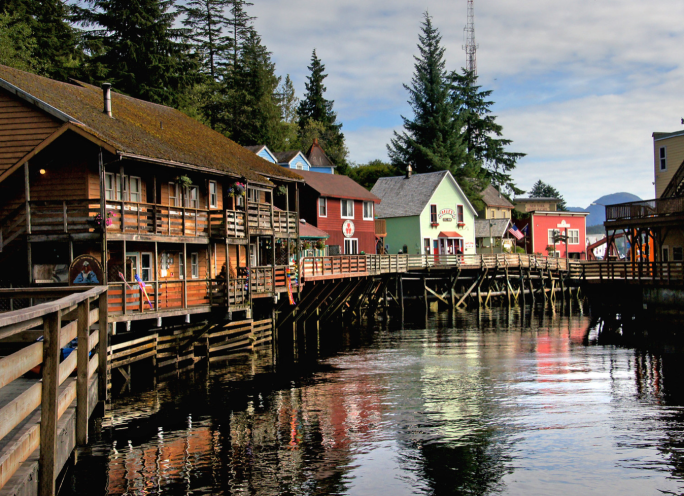
During the mid-to-late summer, salmon can be seen running over the falls and fish ladder at Creek Street, right through Downtown Ketchikan.

Creek Street

Weekly Rundown

All about Ketchikan, Volume One.

Well, Covid seems to be playing havoc with my work schedule. I might as well post some information that you might find interesting.

The City of Ketchikan, AK sits on Revillagigedo Island, which is about 89 km (50 mi) long from north to south and 48 km (35 mi) wide from east to west, making it the 12th largest island in the United States and the 167th largest island in the world.

The island is separated from the Alaska mainland to the east by Behm Canal, from Prince of Wales Island to the west by the Clarence Strait, and from Annette Island to the south by Revillagigedo Channel and Nichols Passage.¹

There are two cities on the Island, Ketchikan and Saxman. The name Ketchikan was chosen as the creek which flows through town is Ketchikan Creek. It was named for Kitsch, a Tlingit native who claimed the section of creek for fishing. Kitsch-hen was anglicized to Ketchikan, as the Tlingit didn’t have a formal written language. Hen translates to creek, and Kitsch to “the thundering wings of an eagle”.² Aptly, bald eagles fly and nest along the coast up and down the Southwestern shore.

The other city, Saxman, is famous for its totem poles. It has the largest collection of standing poles in the world, which is impressive as the Saxman is only one square mile.³ Many of Saxman’s totems were apparently stolen in the late 1800s during the Harriman Expedition, which I’m currently researching.

Chief Kashakes House in Saxman
  1. https://en.wikipedia.org/wiki/Revillagigedo_Island
  2. http://www.firstalaskacruise.com/ketchikan-historical-highlights.html
  3. https://alaskatrekker.com/places-go/saxman-alaska/

Travel, banned

The world is feeling a little smaller right now. I’m currently sequestered on Revilla Island with two weeks off. I’m about to trek out into the interior and explore some of the trails at my disposal.

I had the option to fly out for two weeks but, in an abundance of caution, I opted to stay put.

At this time when all we know is that very little is certain, it’s better to ere on the side of caution rather than risk

The capital

What’s the capital in Alaska?

A!

Just a silly joke.

Here’s another:

A couple of hikers were prepping for their trek through Denali. At the outfitters, they were given bells and colored ribbons. Inquiring as to their purpose, they were told, “the bells are good at keeping black bears away. Do you know how to identify the bears from their droppings?”

Another hiker leaned over and whispered, “Black bear manure has berries in it. Kodiaks’ will have bells and colored ribbons.”

A new podcast to binge

Tuned into this podcast completely by accident: The Wild with Chris Morgan. Pretty fabulous. I listened to two episodes, the first on our connection with animals and the second on what trees are telling us.

I recommend giving it a listen, and I’ll start a deep dive as I hike some of the Ketchikan trails in my off time. Today I walked Rainbird Trail. I’m waiting for the snow to thaw before I hike up Deer Mountain.

3680E402-2F4E-4603-AD15-648C8C9A0827

Preparations

In getting ready to be away for an extended time I’ve found myself returning again and again to Rolf Potts’s Vagabonding. Some thoughts I’ve had from reading the book:

“Life at home can’t prepare you for how little you need on the road.”

While I’m not backpacking this time around, even sorting out what I need and don’t need has been cumbersome. I’ve stored a portion of my clothes, books, and superfluous ‘things’ that will wait for me until I return, at which point I’m hoping to sell off a good chunk of my goods either at a yard sale or online.

“Reading old travel books or novels set in faraway places, spinning globes, unfolding maps, playing world music, eating in ethnic restaurants, meeting friends in cafes . . . all these things are part of never-ending travel practice, not unlike doing scales on a piano, or shooting free-throws, or meditating.”

– Phil Cousineau, The Art of Pilgramage

Alaska was only a thought, somewhere distant, living at the edge of my periphery. I don’t recall when it took root. But when I visited last year it blossomed. There was a vastness to the country that I had never seen the likes of before – which stood before me in such a way that I felt both insignificant and at the same time a part of the frontier. It was a continuation of something I looked for that first time I was in Europe, and I knew I’d have to go back.

“If you’re already in debt, work your way out of it – and stay out. If you have a mortgage or other long-term debt, devise a situation  (such as property rental) that allows you to be independent of its obligations for long periods of time. Being free from debt’s burdens simply gives you more vagabonding options. And, for that matter, more life options.”

Well, debt is something I’ve considered in painstaking detail since getting out of school. I’ve made some financial mistakes; followed certain passions that weren’t always viable; spent too much, made too little, and sat idle occasionally while trying to reorient myself. Debt is a weight, and I work every day to lighten that load.

“I think if I can make a bundle of cash before I’m thirty and get out of this racket,” [Charlie Sheen says in Wall Street], “I’ll be able to ride my motorcycle across China.”

When I first saw this scene on video a few years ago, I nearly fell out of my seat. After all, Charlie Sheen or anyone else could work for eight months as a toiulet cleaner and have enough money to ride a motorcycle across China.

And that quote from Chapter 1 has stuck with me since first reading it in 2003. My copy of the book is beaten up, highlighted, scribbled in, and full of notes about places I want to see and methods of transportation. I regret not taking the plunge that year. Back when I was debt-free, and I needed a year off from school because I just couldn’t concentrate. But it’s never too late to do what you wanted to do. Sure, maybe it feels a little more complicated. But, it’s not too late.

I was having lunch the other day with some friends, and one of them asked whether I had the wanderlust. Yes, I do.

“To know the universe itself as a road, as many roads, as roads for traveling souls.”

– Walt Whitman, Song of the Open Road

Cello variations

In listening to Bach’s Cello Suites, like I mentioned in this past Weekly Rundown,  I’m reminded of when I purchased my first copy of this album. I was in Chicago, I think February of 2010. I was there doing an audition for an MFA program, which I didn’t get into, but the night before I walked around the City.

I love Chicago. It has all the things I like about New York, with a little more organization. Strange that I should value organization in urban planning, but it was nice to walk a city block and know that the next block would be equidistant.

In a Barnes & Noble downtown, I purchased two CDs – Bach Cello Suites performed by Ralph Kirshbaum from Virgin Classics; and La Boheme, Puccini’s opera with Tebaldi, Bergonzi, Bastianini, and Serafin, from Decca’s Compact Opera Collection.

That same trip I saw Tracy Letts, Patrick Andrews, and Francis Guinan, in Mamet’s American Buffalo at the Steppenwolf Theatre.

I’d only been to Chicago one other time before that when I was very young, and I’m not sure when I’ll go back.

Amish County

I had every intention of showing the various Amish amenities that I experienced in PA. however, plans changed abruptly on Saturday and my photographing time was cut short. Even still, here are a couple of images I took as I wandered around:

B2F94A33-71F4-4F46-9CF4-C342FA420068

933496BA-6CA9-4701-9102-DB9BDEBF350B


The view from a hill in Willow Street, PA. This hill was actually home for a Par 3, but no one was playing golf.


2DAD3551-F6A1-4545-BF0D-E50F71D3E655


This little plot of land was about a mile from the golf course, but on some Sundays, the yard would be full of horse-drawn buggies, the community coming to sit down for a large Sunday dinner.


5F4BB9B3-AC4B-40EE-8638-1468FB61BB30
Custom designs for animal enclosures. 

The weather stopped cooperating on Sunday, and by Monday the winter storm Ezekiel was spreading snow flurries. But up to then, the weather was beautiful. I had seen some horses and carriages as I was driving around, but none while I was out walking. Possibly they were all working somewhere. So wasn’t able to photograph buggies…

I suppose another trip will be required sometime in the future.

Adventuring

I think some of the things that make this world so amazing are the people who go out and live life like no other. Take for instance Leon McCarron. Contributing writer to Adventure Magazine, author of such books as The Land Beyond and The Road Headed West, he set out after University on a bike ride halfway around the world. Then decided to keep traveling.

According to McCarron:

“There was a time when explorers traveled to mark the blank spots on the map—but now, in the digital age with fast, inexpensive transportation to once-hidden corners of our world, there’s far less call for flag-planting.

Instead, I see the modern frontier of adventure as storytelling; using immersive, adventurous travel to uncover new ideas. Adventure also applies on a smaller scale, one that’s accessible for all. It can be a daily practice in which we choose to do something different, something that creates a new experience—and that can happen as easily in London as it can in Ladakh. Adventure is everywhere, if we know where to look.”

The challenge is to create those new experiences. Look for the miraculous in your everyday life.