Recent Items 5

If you like camping, The Dyrt is trying to provide updated information on open and closed campsites around the nation.

Or maybe looking for a new podcast?

If you like to journal, and you’re female, the National Women’s History Museum is interested in your CORONAVIRUS journals.

Saying “No” more, from a 2014 article in the Huffington Post.

Paris, books, c’est l’amour. Used book shopping along the Seine.

And, to soothe the weary soul, the orchestral stylings of composer John Williams, streaming for free until the end of June.

Actively seeking disruption

I’ve spent the past four years seeking a disruptive way of doing things. That includes biohacking, career shifts, travel, focusing on writing, among other things. We live in an age of disruptive technology, and there’s no telling where the next paradigm shift will come from.

Being prepared for it doesn’t mean knowing what it is. Rather, it is expecting it to happen, and merely being prepared.

I think it’s telling that the pandemic sent us into a panic spiral in the way that it did. As a nation, and maybe as a global community, we weren’t prepared for the response required in such a situation.

Anticipation is key for the positive, and negative, adjustments to come.

Ephemeral Internet

The internet gives us an unrivaled tool for accessing information. It has no equivalent. It is a library, forum, school, and community. However, its prevalence is also its disadvantage.

How easy is it to become distracted while browsing the internet. To let our minds, inclined to wander through a biological imperative, just flit from item to item. The vastness of what can be found through mere keystrokes is boundless.

We rely on those who cultivate the internet for us. Give our attention to the screen through which we access this information.

But at the end of the day, it’s still a screen. It’s nothing more a windowpane through which we’re choosing to experience the world. Its content is ephemeral, not tangible.

Sure, getting outside is hard right now. We’ve all been cooped up. But it’s important to still try and have meaningful, real-world interactions. Not just the online ones.

Be you. Be weird.

One of my first shows out of college, I was backstage on Sundays with a handheld UHF/VHF television, probably a Sony Watchman, watching football games. At the time I followed the Miami Dolphins with a religious fervor.

I was new to the theatre. I worked in a sports venue and I grew up a fan of Miami. So, it was just something I did.

In the theatre, there are a number of types. The sports fan is among the rarities. Admittedly I don’t follow sports all that much now. Still own a good deal of Dolphins swag, but I couldn’t even tell you who they got in the Draft.

But the thing is, sports or no, theatre or no, it doesn’t matter what you’re in to. You just need to be you. No one else. Be weird. Be yourself.

The joy of hobbying

I was twenty-five or twenty-six when I transitioned from hobbyist to amateur professional working in theater and film/television. Otherwise known as the time I first got paid for it. (There’s a book with that title, about the tales of Hollywood writers, which I always think of.)

The overlap from hobbyist to paid was such that it’s really all I was doing. Which is the way it’s supposed to be done I think. I had a part-time job in a gym, with a lot of flexibility, and I was auditioning and acting.

Skip ahead many years, and I don’t have a consistent hobby anymore. Well, I suppose this blog qualifies. I write nearly every day, post, and move on. So, yeah. I guess it is!

All that to say, a hobby is this wonderful expression of what interests us. An activity that we can lose ourselves in, even if only temporarily.

We don’t have to do it unless we make ourselves. But most hobbies are such that we want to do them – we don’t have to force ourselves to get up and go work on whatever it is.

Building that model airplane or adding sensors to your drone kit. Constructing Batman’s Batarang out of legos, laying down your own beats in GarageBand, or playing frisbee golf. Unfortunately, if your hobby is group-related (a sports league, or drinking around the world at Disney’s Epcot, for example) you’re sort of stuck for the time being.

But in a hobby you get to focus on your passion, mostly ignoring the outside world. And, right now, who doesn’t want a little distraction?

Recent items 4

A temporary replacement to my weekly rundown. These are things of interest to me which I wanted to share:

  • Just about everything on TWiT.tv. I used to watch Leo Laporte and Patrick Norton on Screen Savers, a show on Tech TV back in the early 2000s. (Wow, just saying that…) While talking to a friend of mine a few weeks ago, those names came up. So I did a quick Google search and found out Laporte had this network. I’ve been diving into a few episodes, both video, and audio.
  • Trey Ratcliff’s photoblog. Not only photography but helpful instructional videos on how to replicate some of his techniques.
  • From Fast Company, is it time to rethink the 5-day workweek? (Yes.)
  • Great advice from former commencement speakers.
  • A multi-narrator reading of Rime of the Ancient Mariner. Even if you don’t think it’s your thing, I highly recommend giving it a listen.
  • And over in France, Le Joli Mai 2020Just over two weeks ago Paris lifted the lockdown, and filmmakers wanted to try something a little unique – but completely French.

Usefulness of lists

I go back and forth on lists. As, really, I do with most things. I’ll find lists useful… until I don’t. Right now, with the chores piled up from being gone for three months, I’m operating on list mode.

Recommendations for how to use lists include:

The purpose of listing to-do items is to get it off your mind. According to David Allen, author of Getting Things Done, “…if it’s on your mind, your mind isn’t clear. Anything you consider unfinished in any way must be captured in a trusted system outside your mind, or what I call a collection bucket, that you know you’ll come back to regularly and sort through.”

While I generally find some way to revel in my procrastinations, my to-do list this time around has been getting checkmarks in the completed column. Here’s to keeping it up.

Cultivating the internet

With so much information on the web, it’s simply impossible to know what you may find. So we turn to cultivators: newsletters, aggregation sites, and web searches.

Since we can’t possibly do it ourselves, we allow trusted advisors to show us the information that we need. Google, Yahoo, Apple News… all provided singular locales to peruse top news stories. Other options include:

  • Setting up a Google alert to keep you informed when topics of interest show up in news items.
  • Getting emails from brands can provide you with information on sales and products, while some even offer daily news updates.
  • Magazines and newspapers also offer daily news (and other) email subscriptions.
  • Tech, finance, education, science, etc., all have their own numerous dedicated lists and newsletters.

The important thing is to not become overwhelmed in the reception of all this information, because then the cultivators just become part of the abundance problem.

Why now is the perfect time to create

There’s a lot to be said for languishing in inactivity. Pablo Picasso is quoted: “Without great solitude, no serious work is possible.”

And this enforced solitude (which may or may not be ending) is an amazing opportunity to find things within you to give to the world. Or, try new things.

We don’t know what’s good and what’s not. So why not just put it out there? If now isn’t convenient to create something, it’s likely no time ever will be.


Measuring the internet

The internet is teeming with more data, more information, more nooks, crannies, and rabbit holes than I can even fathom.

Literally, there is something for each and every person to spend the rest of their lives on, if they so chose.

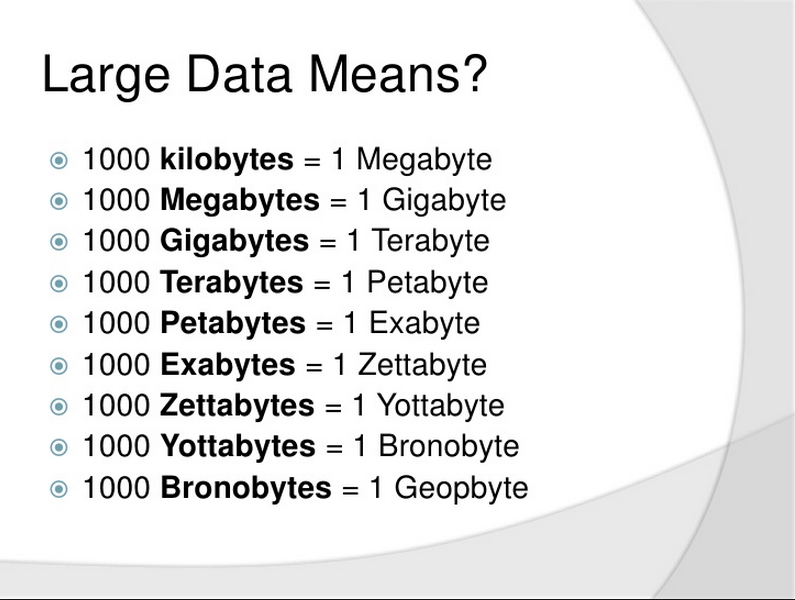
One estimate points to the amount of data stored on servers at Microsoft, Amazon, Google, and Facebook is approximately 1.2 exabytes.

zettabyte.png

More than 90% of the current data online has been created since 2016. Roughly 25 petabytes are added to the internet each day. The Library of Congress blog estimated that, in 2012, it had 10 TB worth of knowledge stored within its hallowed halls.

You would need more than 100,000 complete Libraries of Congress to store the amount of information held on the servers of the four big tech companies. 

Thanks to Google and Bing; smart people creating search engines and utilizing boolean operators, we’re able to delve into the vastness that is the internet. Then it’s just a matter of choosing where to spend your time.