Sitting. Still.

I’ve been practicing my meditation more these past two weeks. My time has been less pressing, at least until I start my next job.  I’ve carved out a little corner with a Buddha, a hamsa, and a zafu cushion.

Some of the guided meditations I’ve used come from the app Insight Timer. I’ve also purchased meditations from the CDM Spiritual Center. The latter was recommended to me from a spiritual healer I had been introduced to back in 2016.

In my meditation, and in my journaling, I’ve been exploring the fact that many of us suffer duality in our lives. The masks we wear for outer acceptance, and the true self that lies somewhere deeper.

The Zen poem Hsin Hsin Ming states:
Faith mind are not two
Nondual faith mind

I suppose I take it to mean that both mind and reality can easily be split in two (or more) parts, if we allow it to. But everything is one whole, and in accepting that oneness, we release that perception of future desires, or past regrets, and live entirely in the moment.

It’s the doing of that which is a bit difficult…
Semiotics

It has to start somewhere,
It has to start sometime.

-Rage Against the Machine

I read a book years ago called Persuasion. I tried re-reading it last year, but didn’t get all the way through it this time. In 2005 I did. (Why I remember the year is not at all important.) In it, Cialidini covers various methods of subtle (and not-so-subtle) persuasive techniques to illicit responses.

Semiotics is the study of sign and symbols, and their use or interpretation. In a way, it’s about cultural norms, how they develop, and how they can be used creatively to illicit responses. It’s a single word representing an enormous concept.

I wasn’t aware of semiotics when I read Persuasion, but since I’ve made the connection and it’s been of interest to me since. Persuasive techniques are greatly enhanced if you understand the semiotics of someone’s life – the signs and symbols that trigger positive emotion. It can be religious, familial, or pop culture. But we are inundated with symbols every day, and more and more we become programmed to respond in certain ways.

For our brains, that’s a positive thing. We were historically able to look at a situation and gauge its safety and potential for satisfactory outcome. But now that can be used against us. If we’re unaware of someone setting us up by creating a sense of comfort, then we may do exactly what they want. And sometimes, the wrong people mean harm.

It isn’t that we have to walk around with a running dialogue of the semiotics of every single input we come across. It’s only we must be mindful that sometimes things aren’t what they seem to be.

For a more in-depth look at semiotics, review this sign salad article

Slow the f*ck down

Life sure is fast. 

I started writing this in January. I think it had something to do with cars speeding to places. Why? Because we’re always going. I’ve wrote a lot about time management, staying busy, etc. But what is the answer?

We work too much, to make just enough money to buy what we don’t need, and pay off the debts that we built up spending more than we had yesterday. We plan for more tomorrow, but don’t expect it to be enough because we’re not satisfied with what we have today, hoping that we’ll be satisfied with what we have tomorrow if only we can work hard enough today to make more than we did yesterday.

It’s f*#!ing exhausting. And we are exhausted. Collectively, we are done. You can tell when you look at us. We escape, rather than inhabit. We tune in, turn off – rather than unplug and be. But it’s coming. The change is coming, when we understand it’s not enough just to keep going – but rather that we must find ways of existing that aren’t so damn fast.

Why fasting is a spiritual practice

I started intermittent fasting a few weeks ago, on a trial basis for health and energy purposes. I noticed something, more of a byproduct than an intentional effect:

Meditation becomes easier in a fast.

We’re accosted by thoughts arising from Monkey Brain (or lizard brain, or whatever you’d like to call it). It tells is to eat, procreate, find shelter, drink fluids. It also sends the irrational fear signals. And the criticisms. It’s insidious, and it’s always going.

Now, with a lack of food it tends to focus more on hunger. I become used to thoughts of “is it time to eat yet?” I can learn to tune those out easier, and it’s mostly sending me those thoughts. I’m then able to filter past them and listen to more higher-level thoughts.

It’s been an interesting endeavor, and I’m enjoying the increased concentration from the intermittent fasting.

Maximizing energy

I’m a little over a month in to a new sales job (one of my many avenues for income). I’m on a strict schedule, mostly, and my mornings are starting much earlier than I’ve been used to over the past four years. So, I’m tracking my energy through an Excel spreadsheet, along with other metrics that I think will influence my well-being and state of mind.

Sleep hours, quality of food, quality of day, supplements taken, and creative hours are among the metrics that I’m listing. I may even start breaking down each meal and time I take it in to see where my energy peaks and troughs are. This may sound somewhat obsessive, but biohacking has been an interest of mine for several years now. It’ll be fun to play around with my performance habits.

The Amy apologist

Last year I was in a production of Little Women, the musical with book by Allan Knee, lyrics by Mindi Dickstein, and music by Jason Howland, adapted from the novel by Louisa May Alcott. Admittedly, Alcott is an author I’ve never read (with Senior year English Lit possibly being an exception – I don’t recall), though her contemporaries and acquaintances I’m quite fond of – Emerson, Thoreau, and Longfellow. In the show I was Professor Bhaer.

There is a scene in the show where, after feeling left out by her sisters, Amy burns a story that Jo has been working on. Most people feel revulsion at the act, and Amy’s excuse that Jo has everything and she has nothing comes across as spoiled and bratty.

From my view, though, Amy is nearly a middle child, and shows very little talent of her own. The youngest (who later dies from illness) is loved by all and a budding pianist. Jo writes, and Meg is a proclaimed beauty. Amy therefor feels out-of-place in her own family and thus acts out. It isn’t right for her to do so, but it can be understood.

So, I was labelled an Amy apologist and have been trying to defend my stance for nearly a year. Then I saw a production of Little Women: The Musical just last month, and I thought Amy was a complete brat.

The night is dark

Woke up, after many troubled minutes of trying to get to sleep, with only 90 or so minutes of rest. Again, tried sleeping but couldn’t shut down the brain. It sort of rip-rocketed on overload tonight. There’s a familiar feeling in my stomach, one that harkens back to a night spent on my couch in 2004. Oh, the things you remember.

So, after trying to put myself back to sleep for near an hour, I knew it was impossible. I published my website, started writing, and read a little of Steven Pressfield’s War of Art. This month I finish this book, and check it off my reading list.

Why no sleep? Why is the brain disquieted on this dark night? Because the past is real and it isn’t. Though the Buddha teaches that only the present moment exists, the past has a living representation in our mind. When we recall a feeling, be it hurt or love, it isn’t anything external to our self that is causing that feeling. Only our mind.

And control of the mind is one (of the many) aspects of Buddhism I’ve not mastered.

Thus I decided to take the advice of Jim Collins, who said, “And what I’ve learned is I guess two or three things specifically about the sleep process for me. This is just personal. One, the 20-minute rule. If you wake up in the middle of the night and you check the time — first of all, it’s also by the way fun to see if you can guess what time it is, right? But then check the time. And then if you’re not back to sleep in 20 minutes, get up. Go back to the simple work.”

Sitting in stillness

I fail at meditation more often than I succeed. I do idle well. But doing nothing. That takes some practice.

For many months my meditation practice was an early morning activity. I would generally write my morning pages, then sit and focus on my breathing. Five minutes. Six. Ten. I think I made it to fifteen minutes daily.

The more outside concerns I let creep in to my day, the more difficult it was to focus on meditation. I began missing days. Both of breath work and stillness, as well as my morning pages. The past several months have been completely inconsistent – as evidenced by the frequency of my blog posts.

The outside world isn’t outside. It’s the world, and we are a part of it. It is the lotus blossom, and our job is to hold it in our hands. Each of us.

I’m reminded of a Saturday morning cartoon I used to watch: Where on Earth is Carmen Sandiego?” (now reimagined on Netflix).

Young detective Zack is sitting with a zen monk who is making tea. (This is from a memory of probably 20+ years ago, so it may be hazy). The monk is taking his time preparing tea, and Zack is being anxious. The monk tells Zack to meditate. He says there isn’t time. And the monk responds, “That is why you need it.”

Pure Imagination

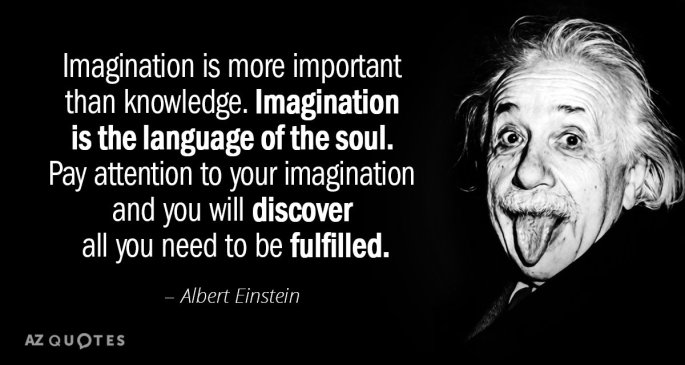
“Imagination is more important than knowledge”

-Einstein

Intelligence is the ability to see things as they are. Imagination allows you to see things as they could be. Is it necessary to see things as they could be?

When the bird sees the twig, does it consider the look of its nest? Or, does it just know? Perhaps that is for the ornithologist.

A better question for me would be, is there a purpose inherent in imagining? And, are some more predisposed to it than others?

Recently I was speaking with someone about their daughter dating an engineer. He wasn’t much for the sense of humor, which the daughter valued highly. The engineer is a practical, oftentimes formulaic person. His no-nonsense approach to life and love could be considered a hindrance in the dating realm.

However, his imagination could rival even the greatest artists. Engineers exceed their limits by knowing precisely what those limits are. Consider the architecture of Frank Lloyd Wright, the skyscrapers of Balcom or Squire, or even the aqueducts of Rome. To see the lay of something so unique as to have never been invented before is the realm of imagination.

As Gene Wilder’s Willy Wonka sang:
“If you want to view paradise
Simply look around and view it.
Anything you want to, do it.
Want to change the world?
There’s nothing to it.”

My soul in stillness waits

In meditation, especially early on in your practice, you will find yourself fidgety. Attention drifts, as it does when we focus on other things as well (work, personal life, wherever). The important thing is not to fight with yourself over the distraction, but to accept it, acknowledge it, and then it let it past you.

Like a rock in a river, many different things may bump and nudge you. You do not push back, but let it roll past you on its own journey.

Mindfully accepting distraction, and releasing it, is as much a part of meditating as the sitting in stillness.