Blog

The Search

“I hope you find what you’re looking for.” That’s what I’ve been told many times.

“I hope you find what you’re looking for.”

The sentiment keeps ringing in my ears, calling to my deeper instincts. It’s three parts:

  1. A wish for something, such as a favorable outcome.
  2. An acknowledgment of longing, of something that is missing.
  3. The promise of a search.

It’s my belief that we’re all looking for something. The ones who can put a name to it are more likely to find it. Yet, sometimes, a name isn’t to be had. If only a name was known, then the quest would be easy.

It’s not always easy. And it’s not always fruitful. But it’s always important.

The weekend provides little relief

It’s been a crazy two weeks, hasn’t it? The health concerns, markets, price of oil, And the weekend isn’t providing much in the way of relief. Now the Fed is dropping interest rates to zero for the first time since 2008 (though that cut lasted until 2015).

The cheaper borrowing may provide an incentive for businesses to borrow or start new programs or build or expand. However, workers feeling the financial crunch that business closures will cause won’t find much hope in a lower Fed rate.

Fear is fear. That which we don’t understand keeps us fettered. While the world waits for answers and relief, each of us throwing our own matchsticks into the night, we expect that the morning will come soon. We hope for it, and we wait for it.

A new podcast to binge

Tuned into this podcast completely by accident: The Wild with Chris Morgan. Pretty fabulous. I listened to two episodes, the first on our connection with animals and the second on what trees are telling us.

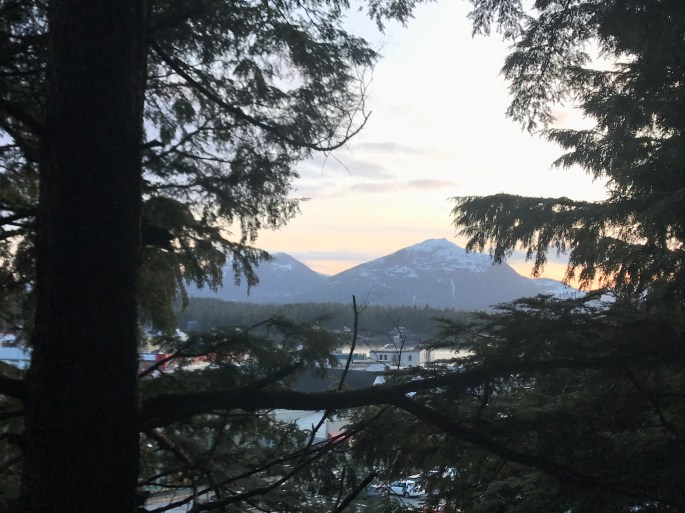
I recommend giving it a listen, and I’ll start a deep dive as I hike some of the Ketchikan trails in my off time. Today I walked Rainbird Trail. I’m waiting for the snow to thaw before I hike up Deer Mountain.

3680E402-2F4E-4603-AD15-648C8C9A0827

Letting go of disappointment

Sometimes it won’t go the way you intend it. Sometimes you’ll make a mistake (or three). You’ll miss a deadline, you’re overestimate or under-deliver. There are a thousand-and-one ways to screw up. And at some point you’ll make that misstep.

But, it’s okay. It happens. More often than not it’s a revoverable misstep, and if it isn’t – it’s not the end of the world. No one has screwed up so badly that the world ceased to exist, because we are still here.

So let it go. Move on. It’s okay. There’s always tomorrow.

What we don’t understand

In the early stages of a panic fear takes over. A fear from not knowing much, of anything, for sure. The more information we have regarding a thing, the less fearful we become.

It comes from being huddled together in the dark, not seeing what happens just beyond the tree line. Once fire illuminated the shadows we were able to conquer those fears.

But as we are the ancestors of those early fire-starters, so too are our fears ancestors of those early shadows. It is important to light the night, and shine upon the unknown, to diminish our fears.

Impostor Syndrome

You want to know something? I don’t know what I’m doing.

Just about every day I ask myself twenty, thirty, fifty times, “What do I want to do? Where do I want to go?”

Sometimes that means what will I write. Other times, it’s where I want to live. Or work. Or play. And I can never answer in the long term.

There are times I feel guilty writing this blog because someone could read it. And, feeling the effects of impostor syndrome, I feel that the reader could have spent time reading something more valuable.

Yes, I try to provide value here. Tips I’ve found helpful, or stories I wanted to share. Places and things that were meaningful to me, or insights I’ve come across. But at the end of the day, it’s just me and my computer. or my notebook, and I don’t have a clue.

Thing is, no one does. Some people make more money or lead what we would call interesting lives. But they are just as lost as the rest of us, searching for answers in their own way.

I write here to practice writing. I write here to be present with something. I write here because it forces me to pay attention to the world so that I have something to write about.

But the hardest things to write are those things hit close to home. Admitting that I don’t know what I’m doing. Saying to myself, and whoever’s reading this, that it’s okay. It’s okay to not know. We’re not meant to know all the answers. It’s the journey that’s important, not the destination.

Weekly Rundown

  • The Outsider… I wanted to watch this show but was waiting. I waited until I heard the Fresh Air interview from Terry Gross with Ben Mendelsohn. I hadn’t known he was Australian. The series is adapted from Stephen King’s novel of the same name and follows the story of a detective investigating a homicide that was committed while the main suspect was sixty miles away on camera. Supernatural and mysterious, the season finale airs this Sunday night on HBO.
  • Super Tuesday. There’s a lot of talk about this day being the day that a clear frontrunner emerges from the primaries. But, where did it come from? This brief history from NPR’s Domenico Montanaro gives the rundown of the term from its start in 1980 and illustrates which elections since then have enjoyed an absence of nomination battles.
  • A quote worth mentioning: “But the traveler’s world is not the ordinary one, for travel itself, even the most commonplace, is an implicit quest for anomaly.” – Paul Fussell
  • Stock Market ups and downs. It’s been an odd couple of weeks, with China being hit hard by the novel coronavirus, and pandemic fears reaching across borders. But, incredibly interesting to watch.
  • And a little bit more from Knives Out director Rian Johnson, this time on why a villain in a movie won’t use an iPhone.


Preparations

In getting ready to be away for an extended time I’ve found myself returning again and again to Rolf Potts’s Vagabonding. Some thoughts I’ve had from reading the book:

“Life at home can’t prepare you for how little you need on the road.”

While I’m not backpacking this time around, even sorting out what I need and don’t need has been cumbersome. I’ve stored a portion of my clothes, books, and superfluous ‘things’ that will wait for me until I return, at which point I’m hoping to sell off a good chunk of my goods either at a yard sale or online.

“Reading old travel books or novels set in faraway places, spinning globes, unfolding maps, playing world music, eating in ethnic restaurants, meeting friends in cafes . . . all these things are part of never-ending travel practice, not unlike doing scales on a piano, or shooting free-throws, or meditating.”

– Phil Cousineau, The Art of Pilgramage

Alaska was only a thought, somewhere distant, living at the edge of my periphery. I don’t recall when it took root. But when I visited last year it blossomed. There was a vastness to the country that I had never seen the likes of before – which stood before me in such a way that I felt both insignificant and at the same time a part of the frontier. It was a continuation of something I looked for that first time I was in Europe, and I knew I’d have to go back.

“If you’re already in debt, work your way out of it – and stay out. If you have a mortgage or other long-term debt, devise a situation  (such as property rental) that allows you to be independent of its obligations for long periods of time. Being free from debt’s burdens simply gives you more vagabonding options. And, for that matter, more life options.”

Well, debt is something I’ve considered in painstaking detail since getting out of school. I’ve made some financial mistakes; followed certain passions that weren’t always viable; spent too much, made too little, and sat idle occasionally while trying to reorient myself. Debt is a weight, and I work every day to lighten that load.

“I think if I can make a bundle of cash before I’m thirty and get out of this racket,” [Charlie Sheen says in Wall Street], “I’ll be able to ride my motorcycle across China.”

When I first saw this scene on video a few years ago, I nearly fell out of my seat. After all, Charlie Sheen or anyone else could work for eight months as a toiulet cleaner and have enough money to ride a motorcycle across China.

And that quote from Chapter 1 has stuck with me since first reading it in 2003. My copy of the book is beaten up, highlighted, scribbled in, and full of notes about places I want to see and methods of transportation. I regret not taking the plunge that year. Back when I was debt-free, and I needed a year off from school because I just couldn’t concentrate. But it’s never too late to do what you wanted to do. Sure, maybe it feels a little more complicated. But, it’s not too late.

I was having lunch the other day with some friends, and one of them asked whether I had the wanderlust. Yes, I do.

“To know the universe itself as a road, as many roads, as roads for traveling souls.”

– Walt Whitman, Song of the Open Road

Why facts and figures are just facts and figures

There’s a lot to be said for statistical analysis. Aside from the obvious, “There are three kinds of lies,” statistics help interpret the real world into manageable bits that our brains can digest. Because, if all we took in was raw data all the time, it would be difficult to make sense of anything.

Once information [from sensory organs] is processed to a degree, an attention filter decides how important the signal is and which cognitive processes it should be made available to. For example, although your brain processes every blade of grass when you look down at your shoes, a healthy attention filter prevents you from noticing them individually. In contrast, you might pick out your name, even when spoken in a noisy room. There are many stages of processing, and the results of processing are modulated by attention repeatedly.

Teach-nology

Statistics works much the same way that our brains filter out “noise”. By collecting data points from related information, we can visualize or understand more complicated systems of data that may otherwise be beyond our grasp.

When we look at a positive trend in the stock market followed by a precipitous decline of share values it can look like the world is coming to an end. But if we retrace the historical data points of the market we recognize its cyclical nature and understand that, at some point, the decline will cease and the market will rise again.

Mark Twain was attributed with the quote as saying, “History doesn’t repeat itself but it often rhymes.”

So I guess what I’m saying is while we may not have the specific facts of a situation to rely on, we can believe that there is a historical context with which we can view it. Knowing that the Spanish Influenza killed approximately 50 million people between 1918-1919 isn’t as important as recognizing that these kinds of pandemics happen, such as in 1957, 1968, and 2009. Investigating what worked and what didn’t can help us today.

And these cycles occur across all industries, geopolitical affairs, and economies. It’s just a matter of finding an applicable context to compare then to now.