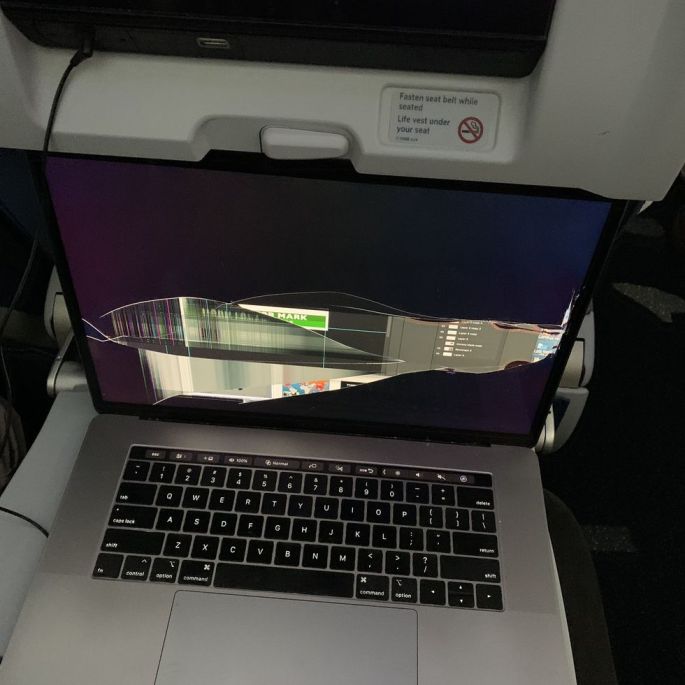
An airplane seat causes a laptop screen to crack. While thankfully this is an unlikely occurrence, it seems to happen enough to get some notoriety.
Be careful out there, when flying the friendly skies.

An airplane seat causes a laptop screen to crack. While thankfully this is an unlikely occurrence, it seems to happen enough to get some notoriety.
Be careful out there, when flying the friendly skies.
It’s was a week of heightened concern for investors. While I generally view downturns as an opportunity for reentering the market, I know it can be disconcerting when you watch 10% of your investment balance just disappear.
From the Wall Street Journal: “Investors are bracing for more volatility ahead. The Cboe Volatility Index, or VIX, jumped to 45.67 early Friday, the highest level since at least October 2011. The VIX, which is based on options on the S&P 500, tends to rise when stocks are falling and decline as markets rise.”
Questions as to how bad the Coronavirus spread will be, or what the resulting financial ramifications may do to the economy are running through the newspapers and television networks. When health becomes a concern, it’s easy to forget rationality.
There are things to consider when it comes to selloffs. Most importantly, it’s primarily led by investment bankers who are concerned about the long-term profitability of their holdings given the health concern. It is in no way an admonition about the stability of any individual company. Some industries will face losses in this cycle, but we’ve seen time and again that cyclical losses are to be expected.
While it’s never clear how long something like this might last, it’s good to remember that it can’t last indefinitely.
Postponed the Rundown for me to ruminate on six months of daily posting yesterday. I still can’t believe it.
My goal with the weekly rundown was to share things of value, and not waste anyone’s time. I’m not sure that it’s been exactly as I intended. Most weeks I struggle to find something to at least list as what I’m listening to or doing. And they’re not actionable by anyone reading. Beyond that, I’ve been delinquent in monthly reading lists for December and January, so I need to rectify that as well.
What then should a weekly rundown from me look like? As I consider it, I’ll probably try a few different things. It’ll likely change with Alaska influencing me as well.
Anyway, here are just a couple of things I’m sharing with you this week.
Today is basically half a year of my posting every day. It’s… unbelievable. I wasn’t sure that I’d make it this long keeping up with daily posts. You get in a groove.
Admittedly, some days are harder than others. Some days I’ve found no time to write, heading from one gig to another. Some days I’ve been able to queue up a week’s worth of posts in one sitting.
One or two days, I just got it in under the wire.
This is a bit of a milestone for me, and thank you for taking any time to read this at all. It’s my practice and testing area; an avenue for thoughtfulness and experimentation; and a crucible of trying to come up with the right word for the right situation. But it’s been one-hundred eighty-three days, and damned if I’m not looking forward to the next six months.
Huh… How about that?
History is not made by those trying to make history. Rather, it is crafted by those trying to improve a problem.
The Wright Brothers saw the flying contraptions of the 19th Century and wondered, “What if they could be controlled while in the air?”
Thus, beginning with the Wright Glider in 1902, airplane controls saw the ability to manipulate roll, pitch, and yaw. They weren’t trying to become historical aviators. They wanted to fix a problem they identified in aviation, and they did.
There’s a collection of things that I intended to return to at some point. An inbox with flagged messages dating back to 2013. Folders with articles and scraps of papers and clippings from newspapers and magazines. All of it held my interest long enough for me to say, “I’ll return to this.” And yet, the stream keeps coming and revisiting any of it seems, at best, questionable.
And yet, there’s the possibility that something in there will spur something here. So I hold onto it.
Some book I read suggested that you should keep a tickler file, containing those things of interest to you that you may want to return to someday – given you have the time. Just make sure you make the time.
Heard this piece from The Why Factor on BBC World Service, all about zombies. It was the noise at the start that got me – this sort of clicking, vocal low growl. It was a little unsettling. But listening through, it got me thinking.
It seems that AMC’s The Walking Dead led this current phase of popularity, and while I thought that maybe the zombie was waining, it seems to still be going strong. Last year’s Zombieland 2 (which I still haven’t seen), popular games like The Last of Us, and the white walkers from HBO’s Game of Thrones all point to a strong showing by the reanimated corpse.
The zombie, and the wider horror genre, is a cyclical beast. While zombies have been en vogue starting from the October 31, 2010 airing of Days Gone By, the first episode of The Walking Dead, they were made popular first, and in their current iteration, by George Romero in his 1968 film Night of the Living Dead. Though Romero lost the rights to that film, it became a lucrative franchise for him as he created five more films in his Dead Saga. Dani Di Placido at Forbes wrote this history of the zombie legend following Romero’s death in 2017.
Before Romero, Americans knew of the zombie mostly from White Zombie, a 1932 film about a Haitian honeymoon with voodoo and raised corpses. The Haitian zombie wasn’t bloodthirsty – it was merely a resurrected person to be used as a slave by a sorcerer. Director Wes Craven revisited this aspect of the zombie legend in 1988’s The Serpent and the Rainbow. In A History of Zombies in America from NPR’s Rachel Martin and Rund Abdelfatah, the Haitian beginnings of zombies are explored in depth.
Through the 80s and the 90s, zombies got more of a B-movie treatment. Slasher films were the mainstay, with films like Friday the 13th, Nightmare on Elm Street, and Sleepaway Camp following up on the popularity of 1978’s Halloween. The masked killer got a revamp in 1996 with Wes Craven’s Scream, ushering in a smarter, meta-version of the slasher film.
While the film industry wasn’t doing great with zombies, video games were killing it. The Resident Evil series, started in 1996 for Playstation, was immensely popular and eventually got its own film adaptations as well. Additionally, new life for the zombie came in the 2000s, including the 28 Days Later, Shaun of the Dead, and the 2004-remake of Dawn of the Dead. In 2003, Robert Kirman began the long-running series Walking Dead for Image Comics, which would be adapted to television by AMC.
And books as well get the zombification treatment, with popular novels like Max Brooks’s World War Z, Stephen King’s Cell, and M.R. Carey’s The Girl with All the Gifts, not to mention the Seth Graham parody mashup of Jane Austen, Pride & Prejudice & Zombies.
So while I echo Romero’s sentiment that the zombie genre has become overrun in recent years, there is still plenty of material to pull from for a bevy of stories to tell about the living dead. I suppose horror, and its fan-base, is just waiting for the next resurgence – maybe it’ll be Universal Monsters this time around.
Further reading:
“If you don’t break your ropes while you’re alive
do you think
ghosts will do it after?”– Kabir
“Writing is easy. Just put a sheet of paper in the typewriter and start bleeding.”
– Thomas Wolfe
This quote has come up a few times, one a variation credited to Hemingway, others to authors I’ve not known before. But the quote has been rolling around in my head for days.
I read Cheryl Strayed’s Wild and I felt a very intimate sense of who she was, how she suffered, and what the journey meant. She bled, literally on the trail, and figuratively on the page. She exposed who she was.
It’s my intention to do the same, but in the writing, I always feel a bit of a filter in place. Not so much a mask of how I want people to see me, but more a guardedness about letting anyone become too intimately aware of my existence. Some sort of desire to remain among the transient awareness of reality.
It’s partially to blame for the vagabonding spirit I suppose. Anywhere I go, I can just as suddenly depart. While I’ve made many friends along the way, and good ones, any of them will say that I’m a shit-communicator when it comes to keeping in touch. Family likewise feels I stay distant, and I do.
I’m hopeful my summer will reveal more about me than I understand at this point. Cautiously optimistic, as anywhere you go, there you. But among the work requirements and the exploration, I’ll be sitting down at the computer and trying my best to bleed.
Here’s to whatever may come.
It’s easy to view the world through a consumer’s lens. We’re bombarded by nonstop marketing all day long, and we forget that it’s a two-way Street.
Choices are a form of participation. We become part of the dialogue, as long as we take control of our actions rather than following programming blindly.
Considering all choices, and why we make them, will lead us to living a more engaged life.
 Michael's Musings