Ticking by…

I’m watching the days on the calendar just push ahead, much more quickly than I would have liked. Already we’re nearly into June, which will have me off on an Alaskan adventure, followed by more work for the foreseeable future.

I believe that we oftentimes focus so heavily on the day-to-day that we neglect the future. I have a sticky note (lost in repeated shuffles, so it’s time for a new one) which reads, “Will this get me closer to my mountain?”

The concept came from Neil Gaiman’s Make Good Art speech, and it’s a sort of guiding light in my harried, busy lifestyle.

Reclamation

No matter what you do, who you are, or how carefully you arrange your days, there will be people who will want your time. Emails, phone calls, text messages, to-do lists, etc.

Spouses do them, and kids, and parents. Bosses an coworkers. Companies you purchase from, and companies looking to sell you something. Reclaiming your time is paramount to living a fulfilled life. Because if your time is always going towards other people’s goals – towards their happiness – you’ve no time left to work towards your own.

Seneca on time

“Continue to act thus, my dear Lucilius – set yourself free for your own sake; gather and save your time, which till lately has been forced from you, or filched away, or has merely slipped from your hands. Make yourself believe the truth of my words, – that certain moments are torn from us, that some are gently removed, and that others glide beyond our reach.”

Being mindful of our time is the first key to freedom, to success, and to many other attributes we aspire to. It is a component of Zen, of meditation, of prayer, and of business. Being present.

Seneca’s assertion to gather and save your time is the fundamental principle of mindfulness.

“…if you will pay close heed to the problem, you will find that the largest portion of our life passes while we are doing ill, a goodly share while we are doing nothing, and the whole while we are doing that which is not to the purpose. “

He continues on asking Lucilius to pay close heed to the problem of time slippage. Stick to the purpose! Which means knowing the purpose.

And what is your purpose? How can you know if you’re wasting time not chasing it, if you’re not really sure what it is?

Or maybe the problem isn’t that you don’t know your one purpose – rather, your purpose is so complex and multi-faceted that you must proceed down several avenues at once to achieve it. And if that is the case, then your attention to time must be even more strict.

Finding time to be creative

You want to do this, be it paint that canvas, write that book, make that movie, or learn that instrument. You want to do that so you can feel the accomplishment you’ve known you longed to feel from the time you first had that thought, probably so long ago.

What no one told you is that it’s very rare indeed to find time to make the art that we long to make. Time isn’t a commodity we just have in abundance. Time is finite, and we have more and more ways to fill it. Five centuries ago it was work, sleep, and family. One century ago it was work, sleep, and family. Even fifty years ago, it could have been work, sleep, and family. Now, the possibilities are endless.

So, no. Don’t find time to be creative. Make time. Schedule it in, and guard it as you would anything else important. It’s the only way to get it done.

Other thoughts about Instagram

There’s a certain joy of democratization of photography that Instagram offers. The only problem is Instagram as a platform has been used to further the vanity of our need-obsessed culture, rather than to express the joy of image – a joy which feels to me that perhaps the programmers had originally intended.

Rather than have an annual edition of Time or NatGeo showcasing the year’s best photographs, here’s a platform with real updates of the greatest photos at this time. Only, we fall short because we find the lowest common denominators. Of course it isn’t that the content is limited on Instagram, but it’s designed in such a way to engage our time – and that’s time that could be spent elsewhere.

Beware

Well, I missed the Ides of March. But what I’ve found more insidious is the barrenness of a busy life.

“Beware the barrenness of a busy life.” – Socrates

There’s so many variables in the busy life, and yet it was the same 2,100 years ago as it is today. If we don’t make time for what’s important in our life, not only do we fill our time with the unimportant but we neglect what is truly vital. Thus our life is barren.

Time is a finite resource

How do you spend it? What does your currency go towards? Are you doing things that make you happy?

Some of the more pervasive questions I’ve been asking myself of late. Over the past two years I’ve had roughly 4 different jobs, and I’m currently interviewing for a new position. (Several, actually, across disparate fields.) I’ve had okay “jobs”, and tended to excel in them. However, much of the work has been hollow. Or left me feeling hollow.

Certainly it’s a societal norm to trade hours for money. And we trade the best years of our life away in a notion that we’ll enjoy our retirement that much more.

Yet I’ve been reading the 4-Hour Workweek by Tim Ferriss (finished it, and have actually begun rereading it). It’s one of those books that resonates with me. The Icarus Deception by Seth Godin was another. Business-focused, creative, and with just enough balls to say that the system may be wrong.

When I was a president of a board, I recall bumping against the mindset often; the mindset that was resistant to change because “it’s the way we’ve always done it.”

And if that’s the kind of mindset I have to fight tooth-and-nail with, is that really how I want to be spending my time?

I think not.

The Art of Stopping Time

I’m often contemplating the lack of time that I have. Mostly I believe it’s self-inflicted. For instance, I’ve signed on to two new shows over the coming six months, and I’m currently working up in Georgia.

For starters, we all have problems. Little foibles that make us who we are, the struggles that define us. Or, that we assume define us.

In some of my recent reading, I’ve found that we can exert more control over how we spend out time. Get off the social media (I barely use it myself now). Quit checking email (but what if I miss something?). We’re all guilty of time-wasters. The things that we tell ourselves are important, when really it’s just FOMO: fear of missing out.

I like this tale from Ferriss’s 4-Hour Work Week:

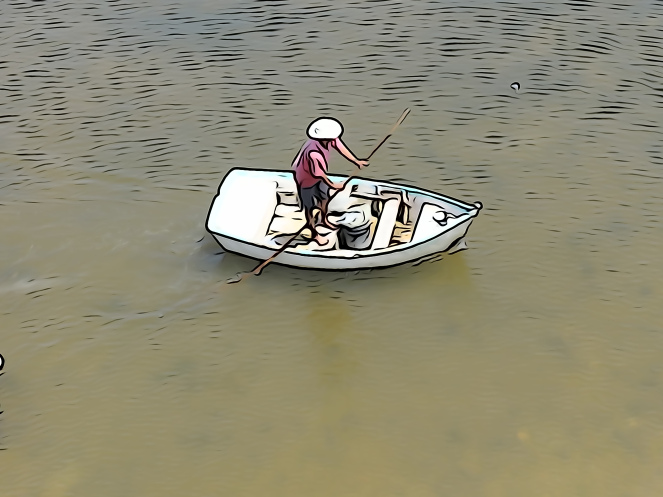
An American investment banker was at the pier of a small coastal Mexican village when a small boat with just one fisherman docked.  Inside the small boat were several large yellow-fin tuna.  The American complimented the Mexican on the quality of his fish and asked how long it took to catch them.

The Mexican replied, “only a little while. The American then asked why didn’t he stay out longer and catch more fish? The Mexican said he had enough to support his family’s immediate needs. The American then asked, “but what do you do with the rest of your time?”

The Mexican fisherman said, “I sleep late, fish a little, play with my children, take siestas with my wife, Maria, stroll into the village each evening where I sip wine, and play guitar with my amigos.  I have a full and busy life.” The American scoffed, “I am a Harvard MBA and could help you. You should spend more time fishing and with the proceeds, buy a bigger boat. With the proceeds from the bigger boat, you could buy several boats, eventually you would have a fleet of fishing boats. Instead of selling your catch to a middleman you would sell directly to the processor, eventually opening your own cannery. You would control the product, processing, and distribution. You would need to leave this small coastal fishing village and move to Mexico City, then LA and eventually New York City, where you will run your expanding enterprise.”

The Mexican fisherman asked, “But, how long will this all take?”

To which the American replied, “15 – 20 years.”

“But what then?” Asked the Mexican.

The American laughed and said, “That’s the best part.  When the time is right you would announce an IPO and sell your company stock to the public and become very rich, you would make millions!”

“Millions – then what?”

The American said, “Then you would retire.  Move to a small coastal fishing village where you would sleep late, fish a little, play with your kids, take siestas with your wife, stroll to the village in the evenings where you could sip wine and play your guitar with your amigos.”

-found on BeMoreWithLess.com