Weekly Rundown

And here it is, my Black Friday edition of the Weekly Rundown. As no one will be reading this today I’ll go ahead and post at 2 am. Good morning!

This Black Friday I’m taking REI’s suggestion of getting out into the wilderness. #OptOutside. I’m up in Pennsylvania, hanging out with the Amish. No, really I am. I’ll put up some pictures later this week. But here we go!

What I’m reading: Not Dracula! Finally finished it. After finishing it, I spent some time with Austin Kleon’s Keep Going: 10 Ways to Stay Creative in Good Times and Bad. I’ve had the book for a while but hadn’t finished it. I dug it out while putting my notebook together, and figured I’d finish it.

What I’m listening to: Audiobook version of Leigh Bardugo’s Ninth House. I listened a lot of the way up to PA. The author’s first book for adults, we have occultism and Ivy League, homicide and mystery. I’d read at least one of Bardugo’s Grisha books before, and this one has much the same flow and tonality; if a bit darker.

What I’m spending time with: Routines. If you’ve read this week you’ll notice that it was a theme. I decided to fix my routine earlier in the month, and as a result I had a few thoughts that popped up. Four posts later, I’m not sure I’m done talking about routines. But that’ll be for later entries.

Other things of interest:

In case you don’t believe me about my skill, here’s one example…
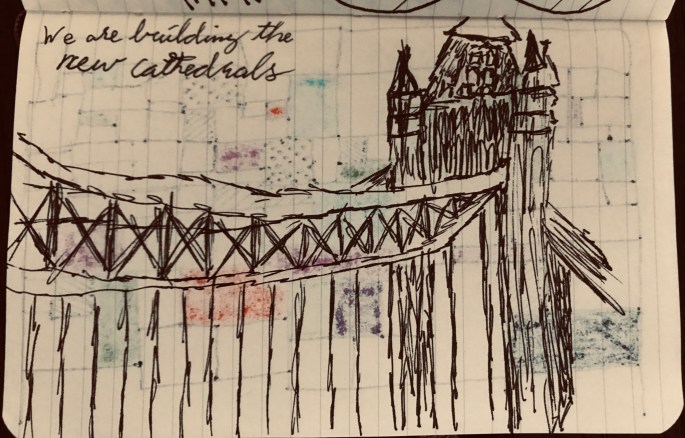
IMG_3538

…and it’s one of my better sketches. But, as I always say: Fail again, fail better! 😉

Routines pt. 4

So, you have a routine that’s working for you. Or maybe several routines that get you throughout your day, or your week. You’re not in a rut, and you’re mindfully going along. The routine’s in place, and now you can avoid any discomfort where your routine is concerned.

Wrong. The discomfort may just be what you want.

If the discomfort is Resistance. As Steven Pressfield said of Resistance, “We experience it as an energy field radiating from work-in-potential. It’s a repelling force. It’s negative. Its aim is to shove us away, distract us, prevent us from doing our work.”

One of the sad things about a routine is that Resistance can use it to discourage us from doing real work. We issue excuses about it not being a part of the routine. We quantify and qualify our responses. We demur.

However, if we’re mindful, and honest, we’ll notice whether or not it’s the work that we need to be doing.

Routines pt. 3

Let’s say you are stuck. You’ve found yourself in a rut that you can’t seem to get out of. Maybe it’s work; maybe it’s a relationship; maybe it’s everything. What do you do?

Like all good programs, the first step is admitting the problem. And you’ve done that now. You have a problem – it’s a rut.

The next step gets harder. Part of solving it is being mindful throughout your day.

The other part is taking an honest inventory of your life. Notice where your attention is pulled. Do you have trouble performing certain tasks as opposed to others? What are you phoning in? What doesn’t really interest you?

If you say it’s your entire job, then maybe it’s time to find something else. But most people tend to enjoy certain aspects of their work, if not the entire situation. Find ways to rekindle that interest.

The same can be true of relationships. Some of the interactions may not be working, but there are probably parts that you still really enjoy. Be honest with yourself.

When we get in a rut, we can put blinders on. We try to ignore where the problem actually is, and focus on the fact that we’re just not feeling particularly happy with our situation. But we have to be honest.

Take a good, hard look. And then evaluate.

Routines pt. 2

There’s a flip-side to routines: complacency. Complacency breeds a feeling of settling. Settle enough times, and you find yourself in a rut.

First of all, it’s easy to find yourself complacent in your situations. Routines can be used to auto-program your life, and then you can just set the cruise control. How to prevent this? Be mindful.

Being mindful in your day-to-day will create moments of miraculous significance – even in the mundane. Being mindful will illicit feelings of joy, and sorrow, and peace. Complacency means you’re looking at your situation and you’re okay with it.

Peace is looking at the situation and knowing that it’s exactly where you are meant to be.

Routines pt. 1

The benefit of routines is the creation of a kind of daily specialization. Routines program your body to daily perform the same tasks (or similar tasks) at the same time. Your body knowing this, it starts to prepare for that task as the time nears.

You free up precious decision-making capabilities, your mind already aware of what you’re going to be doing. Then it can focus on limiting or ignoring potential distractions.

Routines are extremely beneficial, and routines can be designed around any number of specific needs – morning routines; workouts; meal planning; scheduling meetings (or running meetings); etc.

Some examples of morning routines can be found in My Morning Routine from Benjamin Spall and Michael Xander. 99U has a small book called Manage Your Day-To-Day. And of course, Tim Ferriss’s books Tools of Titans and Tribe of Mentors are full of examples you can use.

Christmastime is here…

Today, I’ve set up a Christmas tree, and helped with some outdoor decorations. At two houses. Neither one was mine.

And that’s great! Helping others set up for Christmas is part of getting in the spirit. It’s not a copmpetition of who has the best decor. It’s a collaboration of good tidings.

Here’s a photo of my friend’s house.

4006F6D3-9716-467A-B66D-D3F56DB8D8AC

And my big contribution was making sure that the Y in “JOY” was lit up. Before I helped, it just said “JO”.

And everything else was extension cords.

F99607F0-035D-41E3-9B3F-565FB86CE7CB.jpeg

So, even if we’re not quite to Thanksgiving yet, “Merry Christmas, you filthy animal!”

What you are

There’s a tendency to use the word failure as a description of a person who has failed. But people are not failures. Someone may have failed, but it does not make them a failure. Often, those who fail are persevering.

If you have a disease, you are not that illness. In the same way, if you have failed, you are not that failure.

You are who you are supposed to be. Trying, and failing, and persevering. And that is enough.

Checking in

Every once in a while it’s good to check in. How does this feel? Are you noticing any discomfort?

They tell you this in yoga, but it’s true for life as well. We go through so many days blind to the experience – just getting by. Check in. At least weekly, but daily is better.

My check-ins are scheduled on my calendar, every Sunday. Sometimes I forget them, it’s true. But I know that when I do, I can expect the week to veer off-course in unexpected ways.

When fear leads

There are times when doing that one thing seems so scary, it’s nearly impossible to take the first step. Fear stopping you in your tracks; leading you away from your goals.

Steven Pressfield calls this the resistance. But it has many names. Practicality. Complacency. Normalcy.

The vast majority of us are just skating by, no more sure of ourselves than any other. What we consider to be normal is that same fear leading all of us.

What happens when you give fear the backseat? What do you do? The truth is, only you can answer that. But I bet you it feels a hell of a lot better than letting fear have control.