Blog

Can’t Sleep vol 3

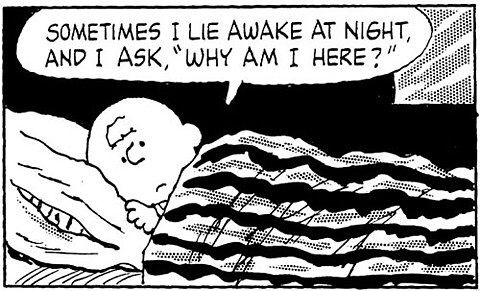
I muse a lot while laying in bed at the end of the day. I'm having trouble sleeping, and I don't know why. I get up early enough. I'll be doing yoga in the morning. I have a pretty full day tomorrow, actually.

I'm thinking about theatre. It's been nearly a year since I was last on stage, and I've just accepted a role in a production of Annie, Get Your Gun. I'm also thinking about what I've been doing with my life these last eighteen months. Plenty of reading, loads of introspection, not much tangible to show. I'm like one of those fresh-out-of-college kids, full of ideas, but no clue on how to make a life for themselves.

Only, I'm about ten years older than most of them.

Trying to plan out the next stages of life.

Where do you want to be in five years, Michael?

Hell, I don't really know where I want to be tomorrow. But I wouldn't mind being well-rested.


Expectations

Why do we elect who we elect to lead us? How do we elect them? What is it about the representative democracy that makes our elections so interesting?

Take a look at the 2016 presidential elections. While Hillary Clinton won the popular vote (65.8M to Trump’s 62.9M), Donald Trump won the election by securing 306 of the 538 electoral votes. So though a majority of Americans voted for someone else, Donald Trump became this country’s 45th president.

The electoral college system has been hotly contested before, especially in the wake of 2000 election, where George W. Bush defeated Al Gore in a narrow victory.

But the electoral college/popular vote debate was also on display following the 1876 election, in which Rutherford B. Hayes defeated Samuel J. Tilden over a matter of twenty contested electoral votes; and also in 1888, when Benjamin Harrison won over Grover Cleveland.

The 1824 election proved interesting as well, with it marking the “final collapse of the Republican-Federalist political framework.” (http://www.ushistory.org/us/23d.asp) Andrew Jackson won the electoral vote, ninety-nine to John Quincy Adams’s eighty-four. But Jackson’s votes only amounted to 43% of the electoral college, and did not secure him the presidency.

It was then that the choice fell to the House of Representatives, under the Twelfth Amendment. In what was decried by Jacksonian supporters, the corrupt bargain gave Adams the presidency, and he in turn nominated House Speaker Henry Clay as Secretary of State.

If we, in a majority vote, elect someone who then isn’t the winner, where does the burden lay? With the system? With the candidates? With the voters?

Maybe we’ll see a change to the system in the coming years. Maybe it’s time.

Be truly whole

Wholeness is acquired from within. It cannot be attained through someone else. Neither can one remain whole when giving in an unhealthy way, as in obsessive love, in that too much of one’s self is surrendered.

As one cannot be made whole by another, so too can one not make another whole. In such attempts vital energy is lost, and even identity, or self, can be harmed.

Being whole can manifest itself in many forms. Spiritual peace or understanding. A true contentment, or satisfaction.

It is a common misunderstanding that contentment is a corollary of settling. Yet, settling by definition implies that some other outcome was desired, but relinquished because it was either too difficult or the settler was too lazy to pursue that outcome.

On the same token as settling is despair. It is a relinquishment of self through the inability to let go of a desired outcome. When in the midst of despair, no outcome seems satisfactory, except for the clung-to ideal that has slipped from grasp.

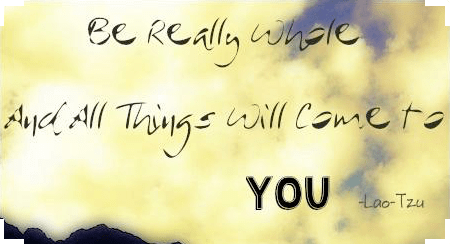
This has a sense of Buddhism to it, or Taoism. The quote that has guided my thoughts on this is, “Be truly whole and all things will come to you.” It is attributed to the Tao Te Ching, and I leave you with the thought:

“Nay, if you have really attained wholeness, everything will flock to you.”

-Lao Tzu, Tao Teh Ching, Passage 22 (John C.H. Wu Translation)

A most important moment

The vast majority of us will never be president. We’ll never be movie stars. We’ll never run Fortune 500 companies, or invent technological advances so profound that they shape human achievement for decades to come.

The vast majority will not become published authors, or produced playwrights. Our canvases or art installations will not be shown in national galleries or private collections. Our musical compositions will not be performed by symphonic orchestras, or sung by operatic professionals.

The truth is, these heights to which we all, at some level, aspire to will be far beyond our reach. However, at one point we’ll look back and see the most important moment in our life. And though it may not hold the immense gravitas of moments in the public arena viewed by millions, it will have been a defining moment in our lives. One that we’ll (hopefully) look back on proudly.

What is that most important moment? Has it happened yet? You already have one, though something more important may come along. Are you proud of that moment? Or would you rather something else takes its place?

We are the heroes of our own stories. Make damn sure the climax is rewarding.

It’s the “W-Word”!!!

The W-Word? What in the world is that?

W-E-L-F-A-R-E

Welfare. Certainly many a number of opinions on it.

So, sometime over the last week I was playing cards. We usually play once or twice a week. At this game topics range from business affairs, the political landscape, entertainment; whatever happens to come up. There are some strong opinions expressed. Oftentimes there’s no small amount of agitation. And yet sometimes I get filled in on things I may have missed.

During this particular game, the discussion of President Trump’s war on welfare to work was brought up. I was admittedly not familiar with this aspect of his policy, so I started where I always start when it’s time to begin research: Google.

Basically, it comes down to the Trump Administration’s budget proposal, which shows significant cuts given to various welfare programs, and requirements proposed for recipients to either work or volunteer if they are able to do so. Well, that doesn’t sound so bad, does it?

But what is welfare?

definition (Oxford Collegiate Dictionary):
1wel•fare \ ‘wel-,fare\ n [ME, fr. the phrase wel faren to fare well] (14c) 1: the state of doing well esp. in respect to good fortune, happiness, well-being, or prosperity 2 a: aid in the form of money or necessities for those in need b: an agency or program through which such aid is distributed
2 welfare adj (1904) 1: of, relating to, or concerned with welfare and esp. with improvement of the welfare of disadvantaged social groups (~legislation) 2: receiving public welfare benefits (~families)

And that seems okay – caring about the well-being, happiness, fortunes, and prosperity of others.

Yet, anytime legislation is created to focus on the public good, there are going to be conceptions of winners and losers.

What of American policies in welfare?

Early welfare systems in America were based on the British “Poor Laws”: “These laws made a distinction between those who were unable to work due to their age or physical health and those who were able-bodied but unemployed. The former group was assisted with cash or alternative forms of help from the government. The latter group was given public service employment in workhouses.”

Changes were made throughout the 1800s, including a push to use caseworkers to evaluate claims. According to the Constitutional Rights Foundation, “During the Great Depression of the 1930s, local and state governments as well as private charities were overwhelmed by needy families seeking food, clothing, and shelter. In 1935, welfare for poor children and other dependent persons became a federal government responsibility, which it remained for 60 years.”

This “federal government responsibility,” known as the Social Security Act, was enacted to provide for the general welfare by establishing a system of Federal old-age benefits, and by enabling the several States to make more adequate provision for aged persons, blind persons, dependent and crippled children, maternal and child welfare, public health, and the administration of their unemployment compensation laws; to establish a Social Security Board; to raise revenue; and for other purposes.”

Welfare history continued to be made when in 1996 President Bill Clinton signed the Personal Responsibility and Work Opportunity Reconciliation Act. Under the act, the federal government gives annual lump sums to the states to use to assist the poor. In turn the states must adhere to certain criteria to ensure that those receiving aid are being encouraged to move from welfare to work. Though some have criticized the program, many acknowledge it has been successful.

Which finally brings us into the current charged political climate. Under the Trump Administration’s budget proposal (introduced now nearly two months ago), the proposal was for the reduction of spending to welfare programs “from food stamps to tax credits and welfare payments by $274 billion over a decade, largely by tightening eligibility for these programs, according to administration officials.

According to Statistic Brain, who pulled stats from the US Dept. of Commerce, the number of Americans receiving welfare government (non-Medicaid) assistance was 67,891,000 in 2016. This breaks down into roughly:

  • 41 million people on SNAP
  • 10 million on unemployment
  • 7.5 million individuals living in a home that receives housing assistance
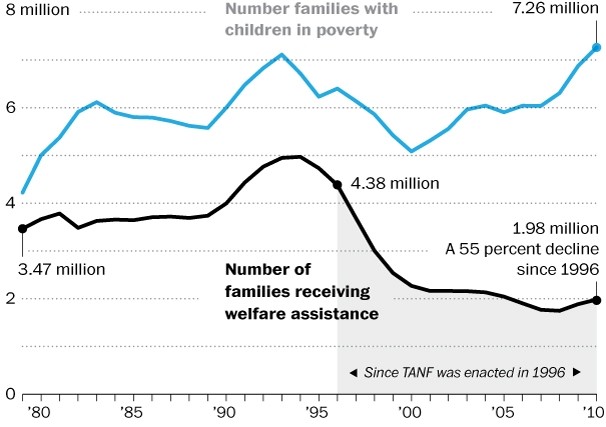
  • 4.3 million received TANF (during previous 12 month period / graphic below shows TANF from 1996-2010)
  • 4.5 million received some other type of assistance


families-receiving-welfare

This remains a hotly debated topic, with arguments on both sides. Each can give statistics to back their case, such as:

“Three quarters of households using SNAP contain children, seniors, or people with disabilities, said Elaine Waxman, a senior fellow in the Income and Benefits Policy Center at the Urban Institute. Without SNAP, the country would have had 3 to 4.5 million more people in poverty during the recession, she said.

or:

“In December 2014, in Maine, the local government chose not to renew its waiver of the Welfare to Work program. At the time, there were 13,332 people who were claiming Stamps and were not exempt from the program; by March, the number of claimants had dropped 80%! More than 9,000 people had decided (or coincidently happened) to either get a job or choose to not claim.

The thing is, I can find statistics from different research organizations, and the results appear contradictory. It’s all in how the information framed. If it comes down to a matter of policy, than the proposed welfare to work provisions seem okay. If it comes down to a consideration of citizens, maybe not so much. For me, I’ll always err on the side of helping those in need, even though there may be some who would take advantage of that.

“A nation’s greatness is measured by how it treats its weakest members.”
Mahatma Gandhi

Disturbances

The phone rings. Who? Why? 

I look at the screen.

UNKNOWN

I wouldn’t have answered anyway.

They call too much.

UNKNOWN

Or otherwise.
In this darkness,
The glowing face of the phone is unwelcome.

In this silence,

The rat-a-tat-tat of some digital ring is unwelcome.

In my loneliness, 

The connection with someone else is unwelcome.

The phone rings again.

Who?

Why?

The Books of Summer

July 2017

Books Bought:

  • Jack of Shadows – Roger Zelazny
  • The Game of Life and How to Play It – Florence Scovel Shinn
  • Your Word is Your Wand – Florence Scovel Shinn
  • The Secret Door to Success – Florence Scovel Shinn
  • The Power of the Spoken Word – Florence Scovel Shinn
  • Arguably – Christopher Hitchens
  • American Fun: Four Centuries of Joyous Revolt – John Beckman
  • The Beauty of Humanity Movement – Camilla Gibb
  • I am a Genius of Unspeakable Evil and I Want to be Your Class President – Josh Lieb
  • Absolutely on Music – Haruki Murakami w/Seiji Ozawa
  • How to Be Like Walt – Pat Williams w/ Jim Denney

Books Read:

  • Fail, Fail Again, Fail Better – Pena Chödrön
  • Ethics – Baruch Spinoza
  • Lone Wolf and Cub, American TPB Vol 15 – Kazuo Koine & Goseki Kojima
  • Schopenhauer – Michael Tanner
  • Jack of Shadows – Roger Zelazny
  • Democracy in America – Alexis de Tocqueville (unfinished…barely started)
  • Annie Get Your Gun – Book by Herbert & Dorothy Fields, Music and lyrics by Irving Berlin
  • Ten Years in the Tub – Nick Hornby (Feb ’04 – Jul ’04)
  • Glengarry Glen Ross – David Mamet

Truth be told, I see this list and I feel it’s misleading. For starters, it really seemed to me that I didn’t read much this month. But that list looks to me like I did. Still, Ten Years and Democracy in America lay unfinished. Schopenhauer and Fail were both small books, and Ethics I read, but didn’t fully understand it. That one may need another read.

And, perhaps I went on a bit of spending spree this month. At least that is what it looks like in the bought section. However, I purchased an ebook containing the four works of Florence Shovel Shinn, who I believe to be a sort of early 20th century mystic, or metaphysics practitioner. She was referenced and credited in Tosha Silver’s book Outrageous Openness, and I decided to give The Game of Life a read, when I can get around to it. The whole shebang was $1.99.

I also have a habit of shopping at the Dollar Tree. This started nearly two years ago, my first time attempting The Artist’s Way program, Julia Cameron’s brainchild on creative reinvigoration. It recommended, as a type of “artist date”, or creative activity to do with, by, & for yourself, that shopping at a dollar store and picking up things that could feed your inner child (or artist) would be beneficial. I like picking through the humble book racks. Over that time, I’ve purchased collected essays of David Foster Wallace; a book on Erasmus; a Vampire Hunter D novella, illustrated by Yoshitaka Amano; and most recently, the following: American Fun, The Beauty of Humanity Movement, and I am a Genius of Unspeakable Evil. All for $1! (Each.)

Arguably, Absolutely on Music, and How to be Like Walt, all full price. Though, I do get a discount for being a member at the bookstore.  I’ve been interested in Hitchens for a while, but haven’t read anything of his yet. Similar with Murakami.

Zelazny was also an ebook purchase, on sale at Amazon. I’m always amazed at the circuitous routes my reading habits take, and when I first read something by this author, I had to have barely been a teenager. It was on a trip to Tennessee, and my mom stopped at an outlet store shopping center, somewhere in Georgia I would think. I loved books, there was a used book store, and my mother was both supportive of my reading habit as well as being generally doting.

I spotted A Night in the Lonesome October among the stacks of discounted books. A hardback, the dust cover adorned with who I assumed Dracula, Sherlock Holmes, Frankenstein and his monster, the Wolfman, and a rogue’s gallery of other characters. This particular hardback was illustrated by Gahan Wilson (who I later learned was a frequent contributor to Playboy, his comics being equal parts humorous and frightening). I still have the book, and will read it every two to three years at Halloween.

Neverwhere was my introduction to the work of Neil Gaiman, who quickly became my favorite author. Missing out the on the Sandman comic series until much later (I was given the first two volumes of Annotated Sandman, and quickly delved in a few years ago), I found great joy in Gaiman’s prose style. The second book of his I purchased was Smoke and Mirrors: Short Fictions and Illusions. The author provides short explanations of each of the stories, including his comments on Only the End of the World Again: “This story came from a number of things coming together… One of them was the late Roger Zelazny’s book A Night in the Lonesome October, which has tremendous fun with the various stock characters of horror and fantasy…”

In Jack of Shadows, we follow the plight of a powerful entity, whose death, rebirth and subsequent search for vengeance is mostly fun. It was a little slow to get into, but once the resurrected Jack is first imprisoned, it begins to feel like a universe created by Zelazny, where possibility and danger are the usual mise en scène. It also hints of political intrigue, and I believe this to be more social commentary than Lonesome October.

As for the others. First of all, thank God for Pena Chödrön’s book. It isn’t that my reading  selections were unreasonably cumbersome. Though, Tocqueville is a whopping seven hundred pages, and I’m barely past the editor’s preface and author’s introduction. To wit, Spinoza’s book isn’t really large either, but the language carries weight that requires more time and attention. Chödrön just happened to be very readable. And pretty small.

Fail, Fail Again, Fail Better is taken from a commencement speech given in CO, and the ensuing interview that was a result. I’ve studied Buddhism for much of my life, in my exploration of theology and philosophy, particularly Eastern practices. Reading of the resiliency of human spirit, the way we can pick ourselves up after failure, is to Chödrön’s credit. She communicates her message of failing in magnificent ways, and I as a reader felt better about failing, as I have in both my recent and distant past.

Tanner’s rundown on Schopenhauer is also small, but at barely sixty pages it still turned into a three-day read. Mind you, the first two weeks of the month I had some difficulty in sitting down to get into anything, and was frequently distracted, fidgety, or just interested in other occupations. C-SPAN, for one. (Take that at face value, please.)

Again, I have a love affair with philosophical works, and should have gone into more heady practices than working with NASCAR, or fundraising for nonprofits. Not that either of those, or the numerous other jobs I’ve worked, can’t be rewarding or wonderful. But I like thinking about things that don’t have a clear answer.

Tanner didn’t really seem to like Schopenhauer all that much. The author was Lecturer in Philosophy at Cambridge until 1997, and was educated in the Royal Air Force. I’m apt to take him at his word, but I don’t have much of an opinion on the philosopher as a person. His concepts on art are well appreciated, especially by music enthusiasts. I’ll likely delve into more serious research on Schopenhauer in the future.

B.S. Baruch Spinoza. In the reading, I stumbled more than once. I wrote on one page of my journal as I was note taking: “Spinoza is full of shit.” Now, he may or may not be correct in any of his assumptions, but I was having serious difficulty reconciling the flow of his logical arguments. (Love philosophy. Just keep telling myself that I love philosophy.)

I did make some headway with Mr. Spinoza through, and I’ve turned from complete detractor of process to more of a curious doubter. I’m hoping to read through some of his correspondence over the coming months, to try and get a clearer picture of what he was talking about.

The rest was mostly aperitif. Lone Wolf is a comic series that I’ve yet to read in its entirety. I have the collect trade paperbacks, all 28 of them. I’m halfway through. Those unfamiliar with Kazure Okami, I highly recommend it. A wandering ronin traveling with his son; former executioner to the Shogun, and betrayed by the Yagyu clan. Now he seeks his revenge, while working an assassin in feudal Japan.

kozure-okami-21x28

Mamet’s Glengarry is intensely fun, and the book came in the audio form, from a production done at L.A. Theatre Works. It included such voice talents as Richard Dreyfuss, Richard Schiff, and Joe Mantegna.

Additionally, I sat down to do a read through of Annie Get Your Gun, because I’ll be performing in the show in September. It’ll be my first time on stage in nearly a year, so I’m looking forward to it. This is a musical based on the early romantic endeavors of famous gunslinger Annie Oakley and her to-be husband Frank Butler. I did some early research, to discover that after Oakley died, Butler stopped eating, and joined his wife eighteen days later. How about that?

Expecting a less impressive month for the next post. I’ll be working out of town a lot, and may not have time to read all that I want to. A shame, too, because I’m sure to rack up late fees at the library.



When debating is all we can hope for

The Senate voted this week to begin debate on repealing the Affordable Care Act (Obamacare). The vote ran 51-50, with Republican Senators Susan Collins of Maine and Lisa Murkowski of Alaska voting against, giving Vice President Mike Pence the tie-breaking vote. Later that same day, the Senate voted against comprehensive repeal of the Act in a 43-57 vote.

There was major discussion of partisan politics, including John McCain here, decrying partisan fighting after having to return to vote following his brain cancer diagnosis and biopsy.

“I don’t think any of us feels very proud of our incapacity. Merely preventing your political opponents from doing what they want isn’t the most inspiring work.”

Wednesday saw another rejection of repeal, and discussions moved to a more modest “skinny repeal” of Obamacare, even though House Republicans warn that such policy will be “dead on arrival”. Even still, this tactic fell upon unsympathetic GOP Senators, and all attempts made this week were squelched.

The problem isn’t with a bill, or a desire to repeal. It’s an inability to communicate with one another. Americans are used to policies falling short at both local and national levels. But Americans deserve to know that our politicians are at least trying to talk to each other about how to make a better nation, and a better world.

As we watch the political drama unfold, week in, week out, it is apparent that the current environment is untenable. Something is going to give, and likely give soon.


Art is calling

There’s a piece I’m familiar with, a song called Art Is Calling for Me, lyrics by Harry B. Smith, music by Victor Herbert. It’s a fun sort of song, for a soprano (maybe a mezzo). Every once in a while that music will pop into my head. I first heard it in a concert, sung by a young woman who would enter and, after several years, leave my life. I think of it tonight.

I’ve grown fond of the yoga studio where I practice, as well as the people there. Once a month they do an open house, with live entertainment, food & drink, and, yes, artwork. It reminds me of setting up exhibitions for Orange County, back in a previous occupation.

In my seclusion, or self-imposed monastic existence (as I’ve taken to calling it), I’ve forgotten how much was a part of my life, and just how much I enjoy it.

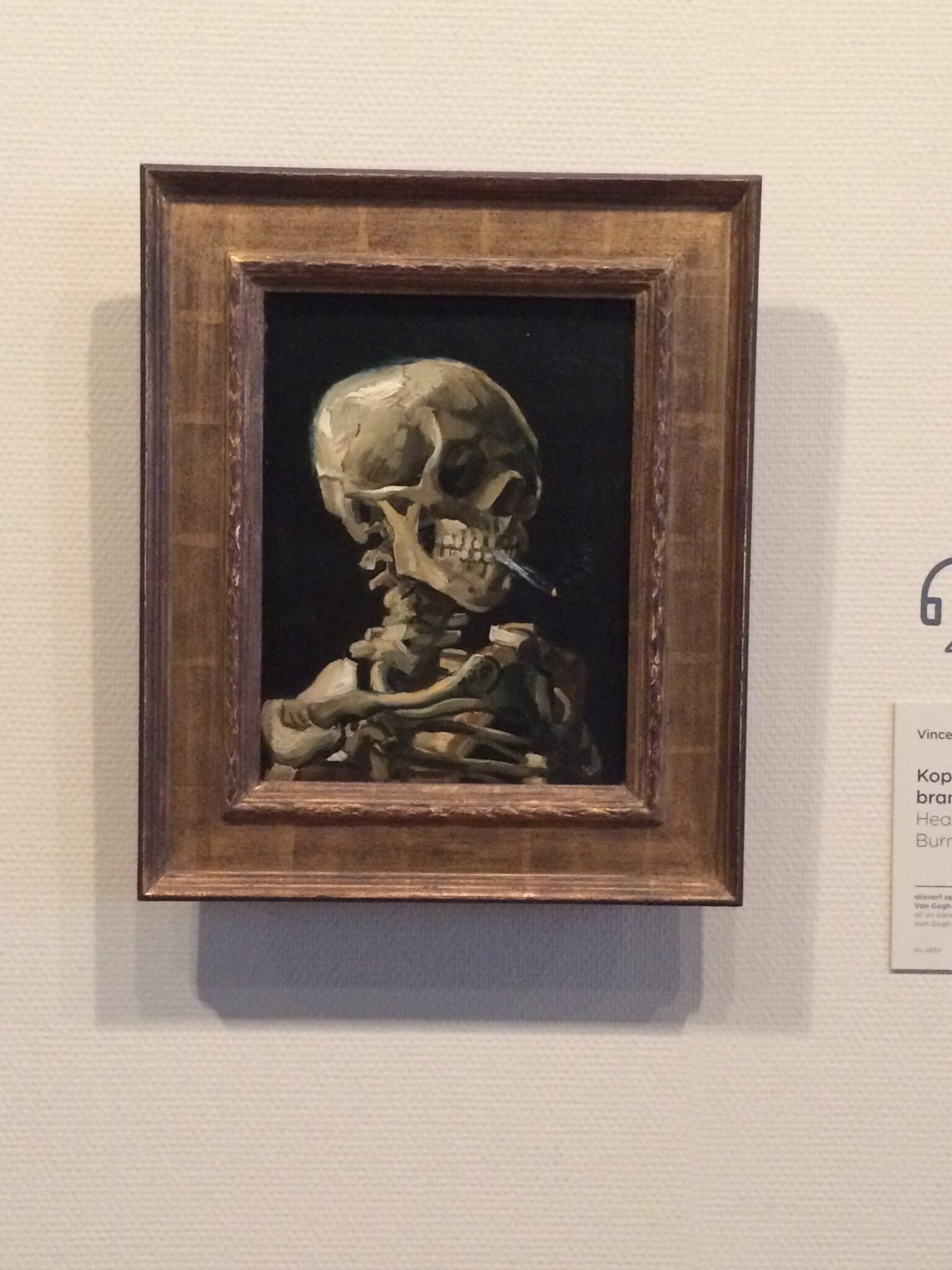
Picasso was probably my favorite, and I did have a chance to see original sketches when curating the exhibitions. While in Amsterdam, I visited the Van Gogh museum. This is one of his that I really enjoyed.

Mostly now I read and write. I go to the movies maybe once a week, or every other week. But, slowly, I’m reentering the world of the arts. Visiting museums. Seeing shows. Listening to music that for a long time was painful to hear. Singing music that I hadn’t practiced in a long time. I guess art is calling…

Untethered

A gifted and persuasive arts advocate I know once told me of advice he received from his mentor. It had to do with focus.

This arts advocate was doing so much – a musician, a fundraiser, a public speaker. He worked with and for numerous organizations. His mentor gave him this advice:

“You can either be a grenade or a rocket. Imagining that the grenade could explode with the same force that the rocket ignites with, the scattering effect of the grenade will reduce the force of the explosion. You want to be the rocket, taking all the force in the direction you want it to go.”

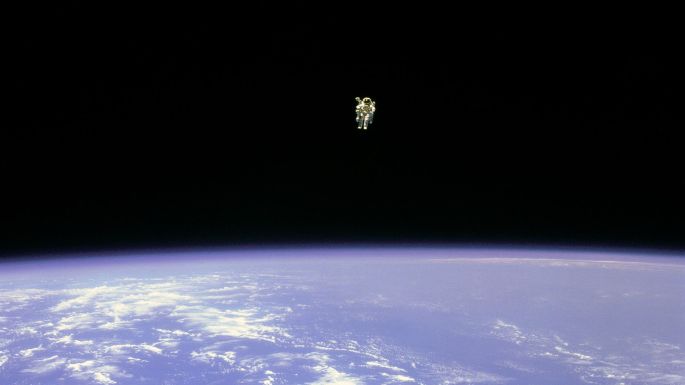
Same energy, but one goes in all directions, and the other is a straight shot. One singular course. A focused ignition.

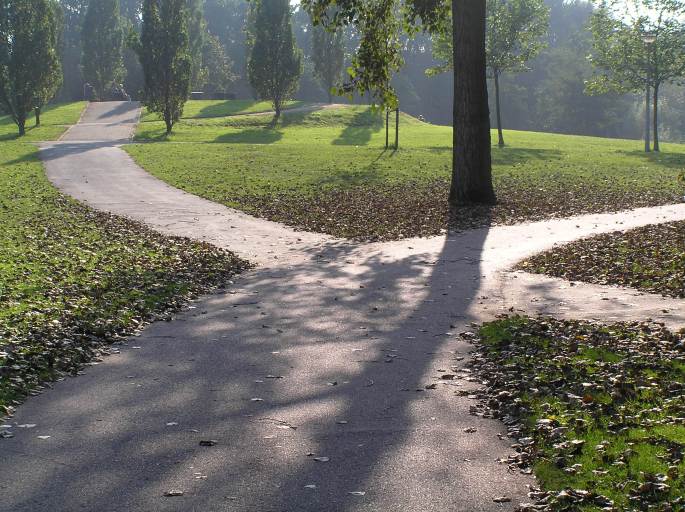
rocket-launchI think about this in relation to various decisions we have to make; crossroads that arise in life. Sometimes, when we think we’re on a singular course, we remain tethered to the crossroad, able to go back should failure occur.
But we can’t utilize the momentum if we’re tied down to where we started. It’s only when the tether is released that we can use the force of the rocket.

Sometimes, the untethering can look to observers like irrational behavior.

Steven Pressfield, in Do The Work!, states, “The three dumbest guys I can think of: Charles Lindbergh, Steve Jobs, Winston Churchill. Why? Because any smart person who understood how impossibly arduous were the tasks they had set themselves would have pulled the plug before he even began.”

Pressfield advocates staying stupid. Don’t let rationality get in the way of your creativity. I don’t necessarily agree with his word choice, but the sentiment resonates with me. Stupidity could be described as irrationality. I can think of several times that I’ve acted irrationally, and I know it was when I moved beyond any safety net I had in place. That’s when failures can happen. Often, they do happen.

But it’s also when the most staggering achievements can be reached. That’s why the following  questions are so important:

  • What would you do if money wasn’t an issue?
  • What would you do if time wasn’t an issue?

You want to learn to play the piano? Or code a computer? Or write your novel? Get back into shape? Eat better, or learn to cook?

“Do you know how old I’ll be when I get done,” you may ask?

Julia Cameron responds to that question in The Artist’s Way: “The same age you’ll be if you don’t.”

When we lose sight of the crossroads, we turn our gaze to the road ahead, and move unwaveringly towards our destination.

crossroads.jpg