When debating is all we can hope for

The Senate voted this week to begin debate on repealing the Affordable Care Act (Obamacare). The vote ran 51-50, with Republican Senators Susan Collins of Maine and Lisa Murkowski of Alaska voting against, giving Vice President Mike Pence the tie-breaking vote. Later that same day, the Senate voted against comprehensive repeal of the Act in a 43-57 vote.

There was major discussion of partisan politics, including John McCain here, decrying partisan fighting after having to return to vote following his brain cancer diagnosis and biopsy.

“I don’t think any of us feels very proud of our incapacity. Merely preventing your political opponents from doing what they want isn’t the most inspiring work.”

Wednesday saw another rejection of repeal, and discussions moved to a more modest “skinny repeal” of Obamacare, even though House Republicans warn that such policy will be “dead on arrival”. Even still, this tactic fell upon unsympathetic GOP Senators, and all attempts made this week were squelched.

The problem isn’t with a bill, or a desire to repeal. It’s an inability to communicate with one another. Americans are used to policies falling short at both local and national levels. But Americans deserve to know that our politicians are at least trying to talk to each other about how to make a better nation, and a better world.

As we watch the political drama unfold, week in, week out, it is apparent that the current environment is untenable. Something is going to give, and likely give soon.


Contentious is the brand

Another week, and another political topic I’ve tasked myself with coming up with. Several ideas sped past my desk over the past few days (incarceration levels, oil pipeline, greenhouse emissions), but I want to do more extensive research on each of these.

It’s difficult to produce content that remains somewhat level-headed, when the right rails against the left, the left against the right; vegetarians against meat-eaters, vegans against both; organic vs. Monsanto; etc., etc., ad nauseum.

When did having an opinion make a person …?

In this book I’ve picked up to start reading, Tibet, the format is contrasting essays by people advocating both sides of the contentious issue as to whether Tibet should have autonomy, or should the People’s Republic of China maintain control.

This book, one in a series titled “Opposing Viewpoints”, has this to say about considering opposing viewpoints:

“In our media-intensive culture it is not difficult to find differing opinions. Thousands of newspapers and magazines and dozens of radio and television talk shows resound with differing points of view. The difficulty lies in deciding which opinion to agree with and which ‘experts’ seem the most credible. The more inundated we become with differing opinions and claims, the more essential it is to hone critical reading and thinking skills to evaluate these ideas.”

So where is the civil in civic discourse? This is a question I’ve been pondering for some time. The greatest minds in American history at least opened up to listen to the opposing side. They may have remained unpersuaded following their interactions, but at least they listened.

“The only way in which a human being can make some approach to knowing the whole of a subject is by hearing what can be said about it by persons of every variety of opinion and studying all modes in which it can be looked at by every character of mind. No wise man ever acquired his wisdom in any mode but this.”

-John Stuart Mill, On Liberty

Title II Protections of Net Neutrality

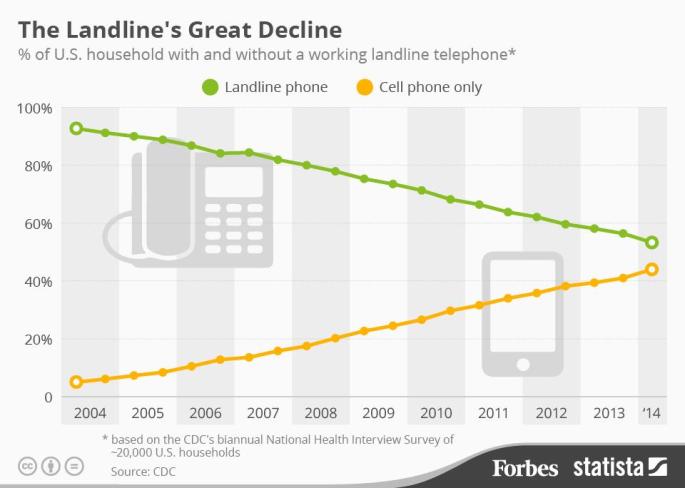
Using any previous ruling as a basis for the extent and prevalence of internet activities is misguided. The technology is rapidly surpassing anything policy-makers could have envisioned even ten years ago. When the 1998 Telecommunications Act was approved by President Clinton, more than 90% of American households maintained landlines. By 2014, that number had dropped to just over 50%, the bulk of that drop occurring between 2004 and 2014 (statistics from the CDC and the US Census Bureau). Considering a drop of nearly 40% in just ten years, it’s conceivable that landlines be irrelevant within the coming decade.

20150226_Landline_FO.jpg

That leaves primary communication capabilities entirely reliant on wireless and internet infrastructures. And the cost-benefit analysis must be equitable and profitable for companies providing such services, as well as for consumers using those services. However, the term service can be misleading in the context with which it is used.

Right now it’s apparent that the focus is on internet as a service. In reality it is more like the route on which services are provided. When the term “communication superhighway” was popularized by then-Vice President Al Gore in the 1990s, it was more than mere hyperbolic language. Consider the free flow of traffic on the web, and how advertisers can set up banners (much like billboards) for visitors and users to see. It is just as beneficial for all users to have access to any sites, much the same way that roads allow clear paths throughout the United States. Limiting net neutrality, the very principle of which is the requiring the same speed and terms with which all internet traffic travels, could be devastating to entire markets of the internet.

In all situations of early, unregulated technological advancements, consumer backlash has led to governmental oversight and regulatory policies and agencies. The Communications Act of 1934, regulating telephony in its nascent stages. Likewise, the Cable Television Consumer Protection and Competition Act (“Cable Act”) of 1992, protecting consumers of unfair practices in cable pricing, and made way for competition in the home entertainment market.

Protection acts are created to ensure fairness and promote new entries into the marketplace. Both the Cable Act and the 2015 Open Internet Order were policies enacted in response to problematic regulation (the former rectifying policies introduced in the 1984 Cable Communications Policy Act, the latter tackling the Telecommunications Act of 1996).

Even in the post-Communications Act era, new technologies led to competitors entering the market, thus improving the experience for users nationwide. For instance, the advent of microwave technologies created improvements in long-distance communications. Under the former monopolistic environment, such competitors may have never been able to get a foothold, and innovations may have been stalled, or even stifled.

When new technologies are introduced to usurp the internet as the primary means of communication, and it certainly will, though as to what form it is going to assume is as of yet unclear, policy changes will be necessary. But at this time it is in the Country’s best interest to maintain net neutrality.

Any rollback of net neutrality could greatly alter the communication landscape of the nation going forward. Knowing this, prior to 2015 the FCC made previous attempts at introducing net neutrality policy. The Courts rejected two earlier attempts and told the agency that if it wanted to adopt such protections it needed to use the proper legal foundation – Title II. Which they turn responded did, by creating the 2015 Open Internet Order.

The argument that the Title II classification reduces the amount of infrastructure investment is flawed. Francis J. Shammo, Executive VP and CFO of Verizon, told shareholders at the 2014 fourth quarter holdings call that the change “does not influence the way [they] invest.” That they would continue investing in networks and platforms, increasing their infrastructure.

Additionally, there are free speech concerns over the adoption or eradication of any guidelines that would prevent companies from blocking or limiting content from websites they deem questionable. As there are currently few alternatives to accessing websites, companies could, in theory, completely undermine entire business models that operate solely on the internet.

Net neutrality is good for internet users, and the free-flow of democratic ideas.

Unerring Independence

On 2 July, 1776, the Continental Congress declared freedom from Britain. The Declaration of Independence was signed 4 July, 1776, and the majority of signatures were given to this document in August.

“We hold these truths to be self-evident, that all men are created equal, that they are endowed by their Creator with certain unalienable Rights, that among these are Life, Liberty and the pursuit of Happiness.”

John Adams said of this new nation, “It was patched and piebald policy then, as it is now, ever was and ever will be, world without end.” We see even today the unique challenges and opportunities of this “American Experiment”.

Alexander Hamilton, in Federalist I, pleads to the people, “Yes, my countrymen, I own to you that, after having given it an attentive consideration, I am clearly of opinion that it is your interest to adopt [the Constitution]. I am convinced that this is the safest course for your liberty, your dignity, and your happiness.”

Two-hundred forty-one years later, we stand with history at our backs. The great men and women of American upbringing, countless immigrants who have made these lands their homes, masters of industry and political prowess; they made way for what we now experience – the boons of prosperity, and the burdens we endure.

When this government was founded, it was a upon a belief of freedom from tyranny, and these new “Americans” died for this conviction.

We the People of the United States, in Order to form a more perfect Union, establish Justice, insure domestic Tranquility, provide for the common defence, promote the general Welfare, and secure the Blessings of Liberty to ourselves and our Posterity, do ordain and establish this Constitution for the United States of America.”

Two documents: a Declaration and a Constitution. These are the backbone of America. We, the people… We comprise everything else. One no greater or lesser than any other. The military is our great skin, protecting us from external forces, and ensuring “common defence.” The three branches of government allows for “domestic Tranquility,” “Justice,” & promoting the “general welfare” of the citizenry.

The “Blessings of Liberty” are ours, and it is with great pride that one can call themselves an American. The political tides will change from time to time in this Country, and it is still at best “patched and piebald policy.” But the belief in this experiment, this liberty and justice for all, guides the people of this Nation towards the unknown future, as it always has done.

George Washington had this to say in his farewell address:

“The unity of government which constitutes you one people is also now dear to you. It is justly so, for it is a main pillar in the edifice of your real independence, the support of your tranquility at home, your peace abroad; of your safety; of your prosperity; of that very liberty which you so highly prize. But as it is easy to foresee that, from different causes and from different quarters, much pains will be taken, many artifices employed to weaken in your minds the conviction of this truth; as this is the point in your political fortress against which the batteries of internal and external enemies will be most constantly and actively (though often covertly and insidiously) directed, it is of infinite moment that you should properly estimate the immense value of your national union to your collective and individual happiness; that you should cherish a cordial, habitual, and immovable attachment to it; accustoming yourselves to think and speak of it as of the palladium of your political safety and prosperity; watching for its preservation with jealous anxiety; discountenancing whatever may suggest even a suspicion that it can in any event be abandoned; and indignantly frowning upon the first dawning of every attempt to alienate any portion of our country from the rest, or to enfeeble the sacred ties which now link together the various parts.

For this you have every inducement of sympathy and interest. Citizens, by birth or choice, of a common country, that country has a right to concentrate your affections. The name of American, which belongs to you in your national capacity, must always exalt the just pride of patriotism more than any appellation derived from local discriminations. With slight shades of difference, you have the same religion, manners, habits, and political principles. You have in a common cause fought and triumphed together; the independence and liberty you possess are the work of joint counsels, and joint efforts of common dangers, sufferings, and successes.”

In closing, I am of the opinion that people may fail, and policies may falter. But the notions with which this Country was established will remain in perpetuity, so long as someone still remains that will say they are American. Happy Fourth of July.

We’re all a little sick sometimes

Healthcare. What a broken system. Same with education. Same with criminal justice. As a matter of fact, any system that should be in place to provide services and care to a country’s population, once it moves to the private sector, becomes a cash cow, pumping returns into wealthy investors’ pockets and political coffers to keep sympathetic lawmakers in power.

Want to fix healthcare? Stop letting the insurance companies run the industry.

We’ve been watching premiums rise, yes, since the advent of the Affordable Care Act (Obamacare), but even before then. There have been grumbling among insurers that costs are just to great under the new political policies to keep premiums at the same level.

However, consider this:

According to an November, 2016 article on Consumer Affairs, Amy Martyn reports that, “UnitedHealth announced record-breaking profits in 2015, followed by an even better year this year. In July 2016, UnitedHealth celebrated revenues that quarter totalling $46.5 billion, an increase of $10 billion since the same time last year.  And company filings show that UnitedHealth’s CEO Stephen J. Hemsley made over $20 million in 2015. To be fair, that is a pay cut. The previous year, in 2014, Hemsley took home $66 million in compensation.”

Okay. Obviously an isolated incident.

However, Ms. Martyn continues on to say: “Aetna, whose CEO Mark Bertolini reported to the Securities and Exchange Commission a $27.9 million compensation in 2015, has similarly celebrated sky-high profits. “In 2015, we reported annual operating revenue of over $60.3 billion, a record for the Company,” Aetna recently told investors.

Yet in this article from an issue last week of the Waco Tribune-Herald, written by guest columnist Merrill Matthews, there’s a little discrepancy regarding Aetna: “Also in May, Aetna said it would pull out of several other states. According to CNN, “The company said it expects to lose more than $200 million in its individual business line this year, on top of nearly $700 million in losses between 2014 and 2016. Aetna withdrew from 11 of its 15 markets for 2017.”

A simple Google search gives me CNBC’s report on quarterly profits for Aetna from January of  this year:

“Aetna’s net profit fell to $139 million, or 39 cents per share, in the fourth quarter ended Dec. 31, from $321 million, or 91 cents per share, a year earlier.

Excluding items, Aetna earned $1.63 per share, handily beating analysts’ average estimate of $1.44 per share, according to Thomson Reuters I/B/E/S.”

Well, man, this is confusing. Either they’re making money, or they’re losing money, but whatever it is it’s in the hundreds of millions of dollars. Okay. Let’s read on in this CNBC report:

“Aetna said its total health care medical benefit ratio — the percent of premiums spent on claims — rose to 82.1 percent from 81.9 percent, a year earlier, mainly due to higher medical costs in its individual commercial products.”

Which means they get to keep 20% of what they bring in, hundreds of millions of dollars. Just for taking money, than turning around and paying to medical professionals.

Yes, they’re moving money from healthy people to sick people. That’s the nature of insurance. But their business model is taking as much in as they can, and pay out as little as they can. That’s profit.

If you want to fix healthcare, get rid of insurance for profit’s sake. Otherwise, it’s one person’s best interest against a corporation driven by profits and shareholders’ best interests.

The week that was

When I first started Michael’s Musings, oh, some point early in the Obama Administration, I really just wanted a platform to rant and rave about what I saw as wrong with politics. Or, what I saw as right about Obama. Or, honestly, who knows. I made one post, and have since moved that to the trashbins of cyberspace.

Still, I’m civic-minded, and I see many things going wrong, and some that are going right. (It seems we always focus on the wrong, and rarely on what’s going right.) I’d like to devote my Sundays to writing about politics, about civics. About discourse that I muse about. So that’s going to be my Sunday devotional. Starting today.

This past week, Jon Ossoff lost in Georgia.

For the record, I was sick of hearing about this race.

I live in Florida. I’m a registered Democrat. The amount of emails was mind-numbing, mostly asking for money, and not giving me a damn lick of information that I cared about.

Problem number one: The message.

What is it you want the American people to know? The voters? The immigrants? The wealthy and the poor, the blue-collar and white-collar? And, most important, you need to stay honest.

Problem number two: How we lose.

I’ve been spending a lot of time thinking about political races, about why we get into politics, about how we run campaigns. (I’m using the Royal “We” here, but I’ve considered running myself from time to time.) I have to believe that we get into politics to make the world, our world and our nation, a better place.

In my opinion, there’s a way to do it, even if you lose. Be better.

That’s it. Be betterDon’t smear, don’t snipe, don’t attack. You may not win a race running it fair, clean, and good. But if the only way you can win is by playing dirty, are you even winning?

That’s the nation that Trump became president in. We live in fear, and we live in troubling times. But even in losing, we can show the nation a better way.

I love the line from Hamilton: The Musical:

George Washington speak-sings, “If I say goodbye, the nation learns to move on. It outlives me when I’m gone.”

Be the example. That’s the point of politics. Be better. And that’s all I have to say for this week.

Why work?

What is the purpose of work? Other than making money, of course. Why are some people so satisfied with their professions, while others are left feeling that what they do doesn’t matter, and they just collect the paycheck and move on with their lives?

To me, work is the calling to something more. We all have gifts, notions about who we are and what we are capable of. I believe that people, deep down, all have a desire to provide help to their fellow man. 
Work is the fulfillment of that desire. Yes, work pays the bills. Or it should. Work is a commitment. Work is the place that we spend a good third of our lives.
Work is not the end-all, be-all. Work is not, or should not be, the daily grind. Work should lift us up, provide a sustainable lifestyle for its employees. We work because we have to, but we should also work because we want to. To do that, the work should be a vocation.
To work is to be interconnected. Within a job, we are part of the whole global economy, not merely isolated in our decisions and choices. What we do, how we do it, and the results of our labors are part of a much larger whole. Neglecting this fact, believing that we operate in a vacuum, is detrimental both to our health and the health of society.

I’m curious right now about the relationship between currency and wealth; of income disparity; the economic state of our Nation and the World. One more topic in the litany of interests I’ll be reading about, or studying, over the coming months. 

The Tides of Change

Driving around town, listening to the Hamilton OBC recording, I realized that a large part of my problem with Daytona (and to a smaller extent, Central Florida) is that nothing is happening here. The area isn’t driving the conversation anywhere. People here can stay put in the time lapse that exists, and change doesn’t come until it trickles from elsewhere. Change isn’t being made here.

It’s an interesting concept. Orlando and Orange County has a thriving virtual reality and simulation industry, but it’s not Silicon Valley, or even Portland, Maine. It’s a smaller semi-hub, and the economic drivers of the area hurts more than aides potential employment. The theme parks create lively destinations, but it’s a tourism-driven industry, and other than conventions or vacations, there’s very little incentive to rock the boat around town.
The thought crossed my mind that perhaps I would feel motivated to spur change here. Some factors prevent me from considering making this home permanent, but that’s neither here nor there.

Change happens where change happens, and that’s historically in the more metropolitan areas. Where bohemia and big business converge, and ideas take shape and take root. There, the tide is continually flowing and all around it either flow with the current or fight to change it. At the outskirts, where the flowing water is rarely felt and merely remakred upon, it’s the quiet acceptance of whatever decisions were made elsewhere. And that’s where dissatisfication lives, or at least a part of it.